Creatine for Women in Perimenopause and Menopause: Is It Worth Taking After 40?
By Margarita Santiago, LE, MA
Licensed Esthetician Since 1999 · Founder of Now & Well
Creatine used to have a very specific reputation. Gym supplement. Bodybuilders. Men trying to get bigger. Maybe a giant plastic tub sitting next to a shaker bottle.
That image is changing quickly.
Now I hear women in their 40s, 50s and 60s asking about creatine for:
strength
muscle loss
brain fog
energy
recovery
bone health
healthy aging
And, predictably, the wellness industry has noticed.
So now we have:
creatine for women
creatine for menopause
creatine gummies
brain creatine
beauty creatine
and probably, somewhere, a very expensive pastel jar that would like us to believe creatine suddenly became a different molecule because the label is prettier.
It didn’t.
So let’s answer the more useful question:
Is creatine actually worth considering for women in perimenopause and menopause?
The answer is:
Maybe yes—especially for muscle and strength.
But not every claim has equally strong evidence.
And creatine is not a replacement for resistance training, adequate protein, sleep, medical care or common sense.
Let’s sort through what we actually know.
First: What Is Creatine?
Creatine is a substance your body naturally makes and uses to help produce energy.
Your body makes some of it on its own.
You also get smaller amounts from foods such as meat and fish.
Most of the creatine in your body is stored in your muscles, where it helps your cells quickly make energy during demanding activity.
That is one reason creatine has such a long history in sports nutrition.
But your muscles are not the only part of your body that uses creatine.
Your brain uses it too.
That is one reason researchers are now looking beyond exercise and studying creatine for things such as:
aging
thinking and memory
mood
brain health
women’s health
A 2025 review focused specifically on women found growing interest in creatine across different stages of a woman’s life, including menopause.
But it also pointed out something important:
We still need more research specifically in women going through perimenopause.
Creatine has been studied for decades.
That does not mean every menopause claim you see online has been proven.
Why Are Midlife Women Suddenly Talking About Creatine?
Because the menopause transition can affect some of the same areas creatine is being studied for.
Women may notice changes in:
muscle
strength
body composition
recovery
bone health
concentration
energy
That makes creatine an interesting option to study.
And unlike many supplements marketed to women in midlife, creatine is not starting from zero.
There is already a large amount of research on creatine in other groups.
The question is how much of that research applies specifically to women in perimenopause and after menopause.
The Strongest Evidence: Muscle and Strength
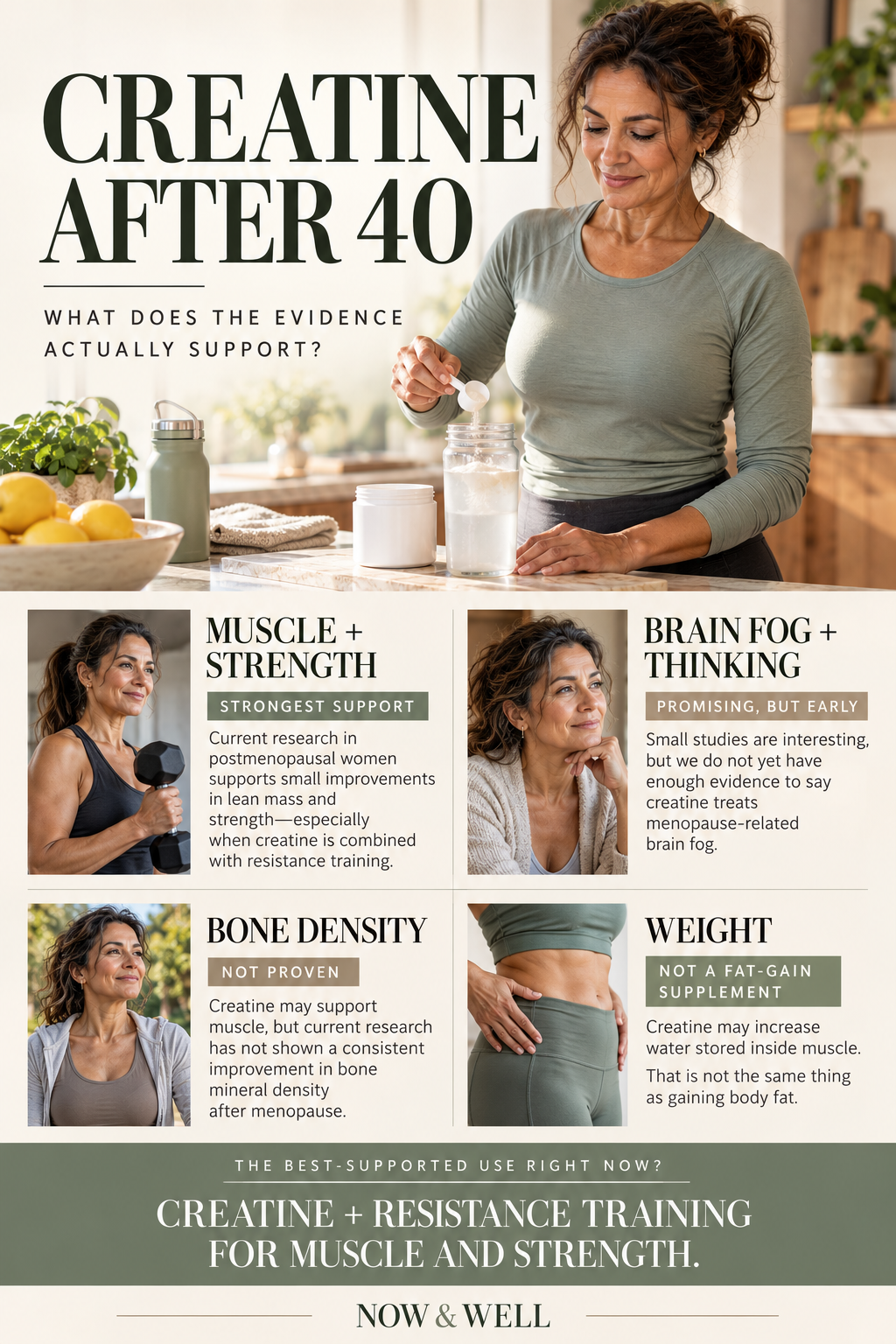
This is where the case for creatine is strongest.
A 2026 review combined the results of seven randomized studies involving 608 postmenopausal women.
The women were around age 62 on average, and the studies lasted from 12 weeks to two years.
Overall, women taking creatine had:
a small increase in lean mass
better leg-press strength
The clearest results were seen when women took at least 5 grams of creatine per day and also did resistance training.
Studies using 3 grams or less without resistance training did not show the same measurable benefit.
That tells us something useful.
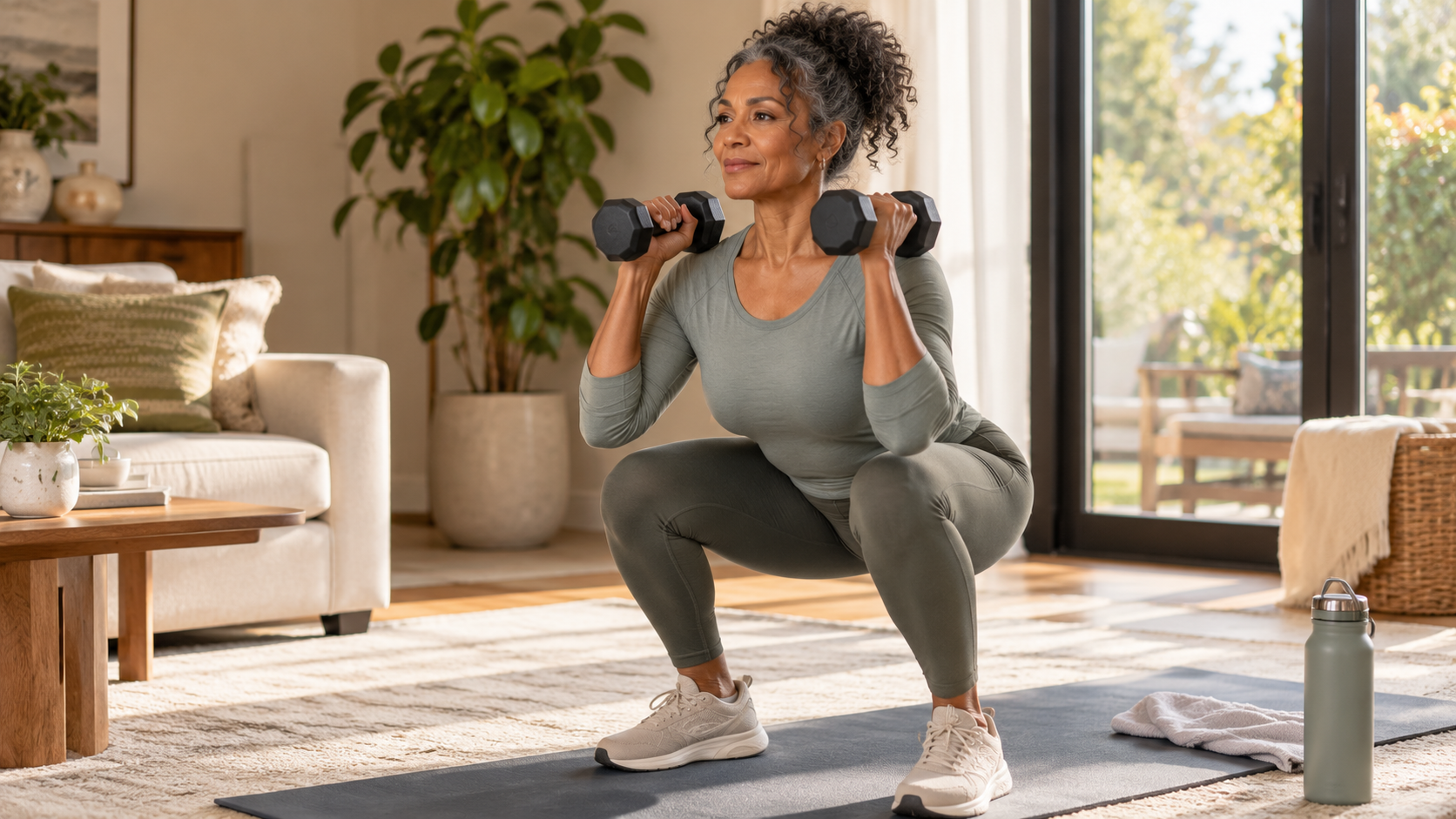
Creatine is not magic powder that replaces exercise. It seems to work best as a partner to resistance training.
That is very different from saying:
“Take this scoop and prevent menopause muscle loss.”
Why Muscle Matters More Than Appearance
I do not want this conversation to turn into another version of:
“Don’t lose your figure.”
Muscle in midlife matters for much more than appearance.
Strength can help support:
mobility
balance
independence
everyday movement
healthy aging
the ability to keep doing the things you enjoy
In the 2026 review, women taking creatine gained an average of about 0.37 kilograms more lean mass than women who did not.
Leg-press strength improved by about 7.5 kilograms on average.
Those are not dramatic transformations.
They are also not meaningless.
Small improvements in strength and muscle can matter over time.
Does Creatine Work Without Exercise?
This is where I would lower expectations.
The strongest recent evidence in postmenopausal women suggests creatine is more useful when it is combined with resistance training.
The same 2026 review found that lower-dose studies without resistance training did not show the same clear benefits.
So if you are asking:
“Can I take creatine instead of strength training?”
I would say:
That is probably not the best use of it.
If you are asking:
“I already strength train. Could creatine help me get a little more from that work?”
That is a much better question based on the research we currently have.
What About Bone Health?
This is one place where the marketing can get ahead of the research.
You may hear creatine promoted as though it clearly prevents bone loss after menopause.
The research does not show that clearly.
A large two-year study included 237 postmenopausal women who took part in resistance training and walking.
Creatine did not improve bone density at the hip, thigh bone or lower spine compared with a placebo.
Researchers did find some changes in the shape and strength measurements of the upper thigh bone that may be worth studying further.
But that is not the same thing as increasing bone density.
Another two-year study involved 200 postmenopausal women with osteopenia who took 3 grams of creatine per day.
That study also did not find an improvement in bone density.
The 2026 review of seven randomized studies came to a similar conclusion:
Bone density did not improve overall.
My translation?
Do not buy creatine thinking:
“This is my osteoporosis prevention.”
That is too strong.
A better way to look at it is:
Creatine may help support muscle and strength, but it should not be treated as a proven treatment for bone loss.
What About Brain Fog and Thinking?
This is one of the more interesting areas, but it is also easy to oversell.
The brain uses creatine as part of its energy system.
That gives researchers a good reason to ask whether creatine might help women who notice changes in concentration or thinking during menopause.
A small study included 36 women in perimenopause or menopause, with an average age of about 50.
Researchers tested several low-dose forms of creatine for eight weeks.
Some of the women showed increases in creatine levels in the front part of the brain and improvements in reaction time.
Interesting?
Absolutely.
Enough to say:
“Creatine treats menopause brain fog”?
No.
Thirty-six women is a small study.
The study also used forms of creatine other than creatine monohydrate.
So I would put brain fog in this category:
Promising. Worth watching. Not proven yet.
Another small 2026 study looked at brain creatine levels and thinking complaints in only 12 women going through perimenopause.
Again:
Interesting.
Not enough to give us a final answer.
Could Creatine Help Mood?
Researchers are also interested in creatine and mood.
Some research outside menopause suggests there may be a connection between creatine, brain energy and mood.
But the research specifically in women going through menopause is still developing.
So I would not buy creatine mainly because someone told you:
“This will fix your mood.”
If strength and muscle are your main goals, any future benefit found for mood or thinking would be a bonus—not the main reason I would recommend it today.
Does Creatine Cause Weight Gain?
This is probably one of the first questions many women ask.
Because nobody wants to hear:
“Take this supplement for healthy aging.”
followed by:
“Also, the scale may go up.”
Creatine can increase the amount of water stored inside your muscles.
That can sometimes increase scale weight, especially when you first start using it.
That is not the same thing as gaining body fat.
That difference matters.
The water is being stored inside muscle as part of how creatine works.
For some women, the scale may barely change.
For others, it may go up a little.
Research looking specifically at women has not found a significant overall increase in body weight compared with women who did not take creatine.
So I would not promise:
“Creatine never changes your weight.”
But I also would not say:
“Creatine makes women fat.”
Those are two very different things.
Does Creatine Cause Bloating?
Some people report stomach discomfort or feeling fuller when they take creatine, especially when taking large amounts at one time.
For some women, taking a smaller amount every day may be easier than using a large “loading phase.”
And you do not have to use a loading phase simply because that is how creatine has traditionally been used in bodybuilding.
For a woman thinking about creatine as part of a long-term wellness routine, being able to take it consistently may matter more than trying to fill the muscles with creatine as quickly as possible.
Does Creatine Cause Hair Loss?
This rumor has followed creatine for years.
The concern came partly from the idea that creatine might raise DHT, a hormone that can play a role in some types of hair loss.
For years, people repeated the hair-loss claim even though we did not have a study directly measuring what happened to hair.
In 2025, researchers finally tested it.
Forty-five resistance-trained men between ages 18 and 40 were assigned to either 5 grams of creatine monohydrate per day or a placebo for 12 weeks.
Researchers measured:
testosterone
DHT
hair density
number of hair follicles
overall hair thickness
They found no meaningful difference between the creatine and placebo groups in DHT or the hair measurements.
That is reassuring.
But here’s the part to keep in mind:
The study was done in younger men.
It was not done in women going through menopause.
So my takeaway is:
Current research does not support the claim that creatine routinely causes hair loss, but we still need research specifically in midlife women.
And if you personally notice more shedding after starting any supplement, you do not need to ignore what you are seeing just because a study found the average person did fine.
Stop.
Look at what changed.
And talk with your healthcare provider if needed.
Hair changes in midlife can have many different causes.
What About Kidney Safety?
This is another question that comes up often.
Creatine can cause your blood creatinine level to rise.
Creatinine is a waste product that doctors often measure when checking kidney function.
Because the words creatine and creatinine sound similar and are connected, it is easy to assume:
creatine → higher creatinine → kidney damage
But that is not always what is happening.
A 2025 review of the research found a small increase in blood creatinine but no significant drop in GFR, which is another way kidney function is measured.
The researchers concluded that the rise in creatinine was more likely related to the way creatine is broken down in the body than to kidney damage.
A newer 2026 review also found that creatinine-based kidney test results could look worse in people using creatine.
But when kidney function was checked using a method that did not depend on creatinine, there was no significant decline.
That difference matters.
But...
If you have:
kidney disease
abnormal kidney test results
a significant medical condition
medications that can affect your kidneys
I would not add creatine casually without talking with your healthcare provider.
And if you take creatine, tell your healthcare provider before they interpret kidney blood tests.
Context matters.
Which Kind of Creatine?
For most women, the form I would look at first is:
Creatine monohydrate
Why?
Because it has the strongest research behind it.
The 2026 review showing benefits for muscle and strength in postmenopausal women specifically studied creatine monohydrate.
You will see other forms advertised as:
easier to absorb
easier on your stomach
more advanced
designed for women
better for menopause
Maybe some of those products are convenient.
But newer does not automatically mean better.
One of my favorite rules applies here:
Do not pay more because the marketing department added adjectives.
And no:
You do not need “female creatine” simply because you are female. A pink label does not make the creatine inside the jar more female.
How Much Creatine Has Actually Been Studied?
There’s a little more to this.
For general creatine use, 3 to 5 grams per day is commonly studied.
But the most relevant 2026 review in postmenopausal women found the clearest muscle and strength benefits when women used:
at least 5 grams per day combined with resistance training.
That does not mean every woman should automatically take more than 5 grams.
It means we should not assume that a tiny amount hidden inside a “women’s blend” will give the same results that were seen in the studies.
Check the dose.
Do You Need a Loading Phase?
Probably not for most women using creatine as part of a long-term midlife wellness routine.
A loading phase means taking a larger amount of creatine for several days to fill the muscles more quickly.
You can also get there more slowly by taking a regular daily amount.
If your goal is long-term strength support rather than preparing for an athletic event next week, there is usually no reason to make this complicated.
When Should You Take It?
Morning?
Before exercise?
After exercise?
The internet can turn this into a very serious debate.
For most women, I think the more useful question is:
When will you actually remember to take it?
If putting creatine in your morning drink means you consistently take it every day, that may matter more than worrying about the perfect time.
Do You Have to Take It Every Day?
Most studies use creatine regularly.
That makes sense because the goal is to keep creatine stored in the muscles over time.
Creatine is not like caffeine.
You are not taking it because you expect to feel it “kick in” ten minutes later.
Consistency matters more.
What Should You Mix It With?
Water.
A smoothie.
Another drink you already enjoy.
It does not need to become an elaborate wellness ritual.
If you choose a powder, pick something you can realistically use consistently.
Gummies vs. Powder
This is where marketing can get expensive very quickly.
A gummy may absolutely be more convenient.
But before buying one, check:
how much creatine is actually in one serving
how many gummies you need to get that amount
added sugar
cost per useful dose
whether the product actually uses creatine monohydrate
If you need several expensive gummies every day to reach the amount used in research, convenience may become very expensive.
That does not mean gummies are bad.
It means:
Do the math.
Creatine Isn’t a Replacement for Protein
This is worth saying because both are talked about constantly in midlife fitness.
Protein gives your body the building blocks it needs to maintain and build muscle and other tissues.
Creatine helps your muscles quickly make energy and may help you get more from your training.
They do different jobs.
They are not substitutes.
If you are not getting enough protein, adding creatine does not fix that problem.
And creatine does not replace strength training either.
The Strongest Combination Looks Pretty Simple
The current evidence points toward a pretty simple combination:
Resistance training
+
enough protein and good nutrition
+
creatine
+
consistency
No complicated “hormone-balancing” supplement stack required.
What About Women Who Don’t Want to “Bulk Up”?
Creatine does not suddenly turn a woman into a bodybuilder.
Building a large amount of muscle takes training, nutrition, time and genetics.
The small increase in lean mass seen in studies of postmenopausal women is better understood as supporting muscle.
For women in midlife, maintaining muscle and strength is something I see as a positive—not something to fear.
What About Creatine and Menopause Weight Changes?
Creatine is not a weight-loss supplement.
It is also not a treatment for changes in belly fat or body shape that can happen around menopause.
If your reason for considering creatine is:
“Will this make my belly fat disappear?”
That is not what the research supports.
Its more realistic role is around:
strength
muscle
exercise performance
possibly thinking and brain health
That is enough.
A supplement does not have to solve every midlife problem to be useful.
Who Should Talk to a Healthcare Professional First?
I would be especially careful if you have:
kidney disease
abnormal kidney test results
a significant ongoing medical condition
medications that can affect kidney function or fluid balance
unexplained swelling or fluid problems
pregnancy or breastfeeding
Also tell your healthcare provider that you take creatine if your kidney function is being monitored, because creatine may affect your creatinine blood test.
THE NOW & WELL CREATINE CHECK
Before buying creatine, ask:
1. What am I hoping it will help?
Muscle?
Strength?
Exercise performance?
Brain fog?
Bone health?
Different goals have different levels of research behind them.
2. Is that benefit actually supported?
Muscle and strength:
Better supported.
Brain fog and thinking:
Promising, but we need more research.
Bone density:
Not proven.
3. What form am I buying?
Creatine monohydrate has the strongest research behind it.
Do I have a real reason to pay more for another form?
4. How much creatine is actually in the product?
Do not assume a “menopause creatine blend” contains the amount used in research.
Read the label.
5. Am I strength training?
The strongest results in postmenopausal women were seen when creatine was paired with resistance training.
6. Is the price reasonable for what I am getting?
Basic creatine powder can be inexpensive.
Fancy packaging can change that very quickly.
7. Do I have a medical reason to check first?
Kidney disease, certain medications or other health concerns deserve a conversation with your healthcare provider.
So, Is Creatine Worth Trying?
For the right woman?
Yes. This may be worth considering.
Especially if:
you are in midlife or postmenopause
maintaining muscle and strength matters to you
you resistance train or plan to start
you want an affordable supplement with a large amount of research behind it
you understand that the strongest evidence is for muscle and strength—not every menopause symptom
Maybe—but only for the right person.
If your main interest is:
brain fog
thinking
mood
bone health
there is enough research to keep watching, but I would not tell you those questions have been completely answered yet.
No. Save your money.
If the product:
contains very little creatine
hides the amount inside a proprietary blend
charges dramatically more because it says “for women”
promises weight loss
promises to “balance your hormones”
promises to prevent osteoporosis
tells you it will replace exercise
I would keep walking.
The Bottom Line
Creatine is one of the more interesting supplements entering the conversation about women in midlife because it is not built entirely on hype.
There is real research behind it.
The strongest current evidence in postmenopausal women suggests small but meaningful benefits for muscle and strength, especially when creatine is combined with resistance training.
The research on brain fog and thinking is interesting, but still early.
The research does not show a clear improvement in bone density.
The kidney question is not as simple as social media makes it sound.
And current research does not support the claim that creatine routinely causes hair loss—although the direct hair study we have was done in younger men, not menopausal women.
So no, creatine is not a menopause miracle.
But unlike many products being marketed to women after 40, it may genuinely deserve a place in the conversation.
And that is exactly what I want Wellness at Now & Well to do:
Not tell you to buy everything.
Help you figure out which things may actually solve a real problem for the woman using them.
This article is for general educational purposes and does not provide medical diagnosis or treatment. Consult an appropriate licensed healthcare professional for medical concerns.
Still deciding what belongs in your routine?
If you’d rather have someone review what you’re using, what changed, and what may actually make sense for your skin now, The Midlife Skin Reset consultation is designed for exactly that.