
I prefer natural approaches whenever they make sense.
That does not mean I believe everything with a leaf on the label is automatically safe, effective, or worth spending money on.
And it definitely does not mean I think women should have to choose a team: natural or conventional, supplements or medicine, herbs or hormones.
Midlife is complicated enough without turning menopause into another argument.
I’m in my late 50s, and I’ve tried natural approaches myself. Black cohosh was helpful for me, particularly with hot flashes. I’ve also used O Positiv menopause-support products and personally noticed fewer hot flashes and improvement in vaginal dryness.
That is my experience.
It is not proof that those products will work the same way for you.
And that distinction matters.
Because when I started looking more closely at the research behind some of the things women are taking for perimenopause and menopause, I found exactly what I expected: a few options with genuinely interesting evidence, several with long histories of traditional use, some with mixed research, and quite a few products making promises that are much stronger than the science behind them.
So this is not going to be a list of the “10 best menopause supplements.”
You don’t need ten more things to buy.
You need a better way to decide what may actually be worth trying.
First: What Symptom Are You Actually Trying to Treat?
Before you buy anything labeled MENOPAUSE SUPPORT, stop and ask one question:
What exactly am I trying to improve?
Hot flashes?
Night sweats?
Difficulty sleeping?
Vaginal dryness?
Pain with sex?
Mood changes?
Brain fog?
Stress?
Low libido?
These problems may all show up during the menopause transition, but they are not necessarily caused by exactly the same thing—and they do not all respond to the same treatment.
That sounds obvious.
Yet the supplement aisle often treats menopause as though it were one giant condition requiring one giant bottle containing 17 herbs, six vitamins and something harvested from a mountain you’ve never heard of.
The better approach is:
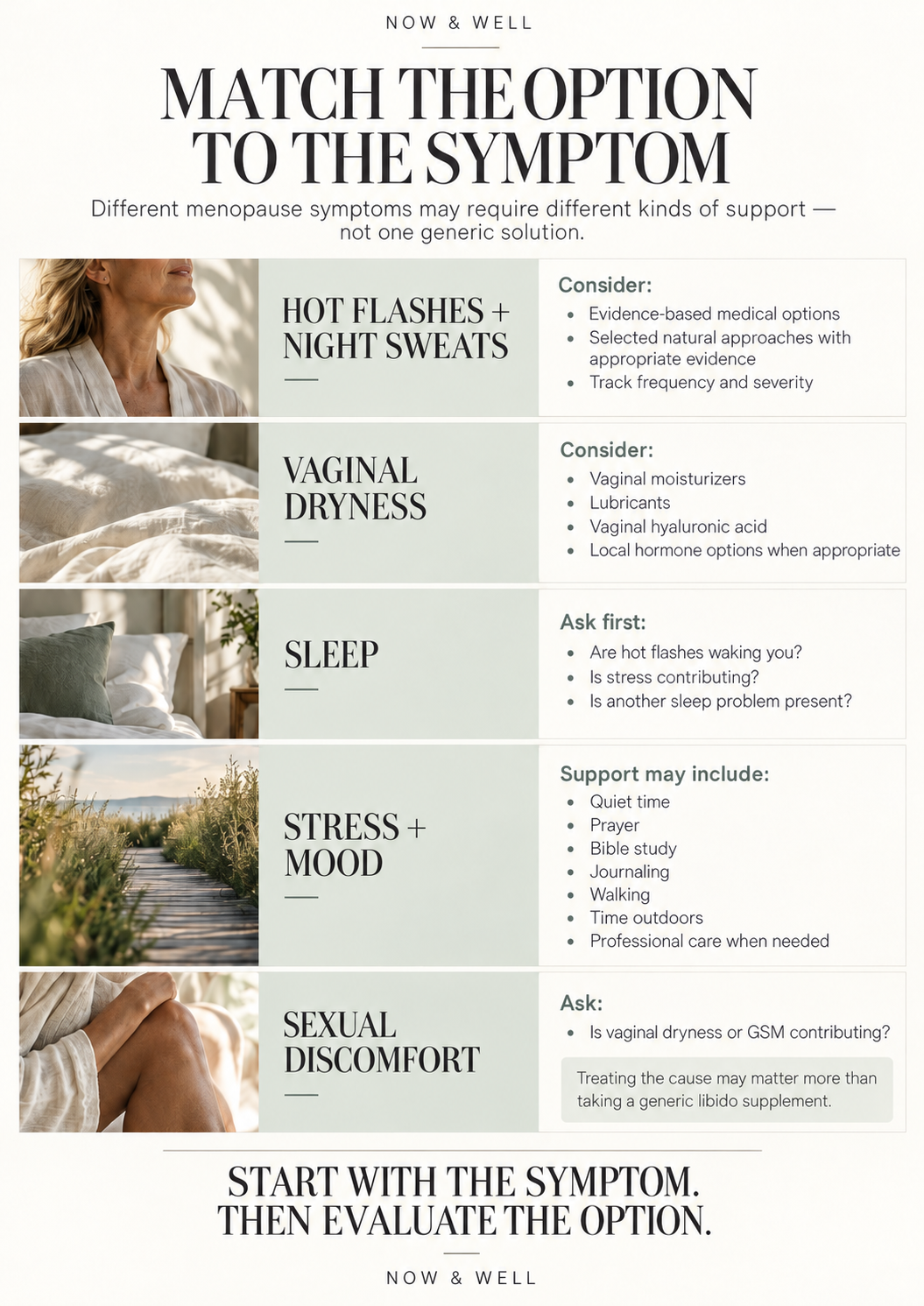
Match the intervention to the symptom.
If hot flashes are your biggest problem, evaluate options that have actually been studied for vasomotor symptoms.
If vaginal dryness is the problem, treatments directed at vaginal tissue may make considerably more sense than taking a generic “women’s hormone balance” capsule and hoping for the best.
And if you’re waking at 2 a.m. because a hot flash is drenching the sheets, the sleep problem may partly be a hot-flash problem.
Start with the problem.
Then evaluate the solution.
Natural Doesn’t Automatically Mean Safe—and Conventional Doesn’t Automatically Mean Better
This is one of the principles I want Now & Well to come back to again and again.
Natural does not automatically mean safe.
Hemlock is natural. We aren’t putting that in a wellness gummy.
At the same time, limited clinical research does not automatically mean that centuries of traditional use should be dismissed as worthless.
The reasonable middle ground is to ask:
- What has this traditionally been used for?
- Does the proposed mechanism make sense?
- Has it been studied in humans?
- How good were those studies?
- What are the possible risks?
- And does what women experience in the real world broadly line up with—or contradict—the research?
That’s a much more useful conversation than “natural good, medicine bad” or the reverse.
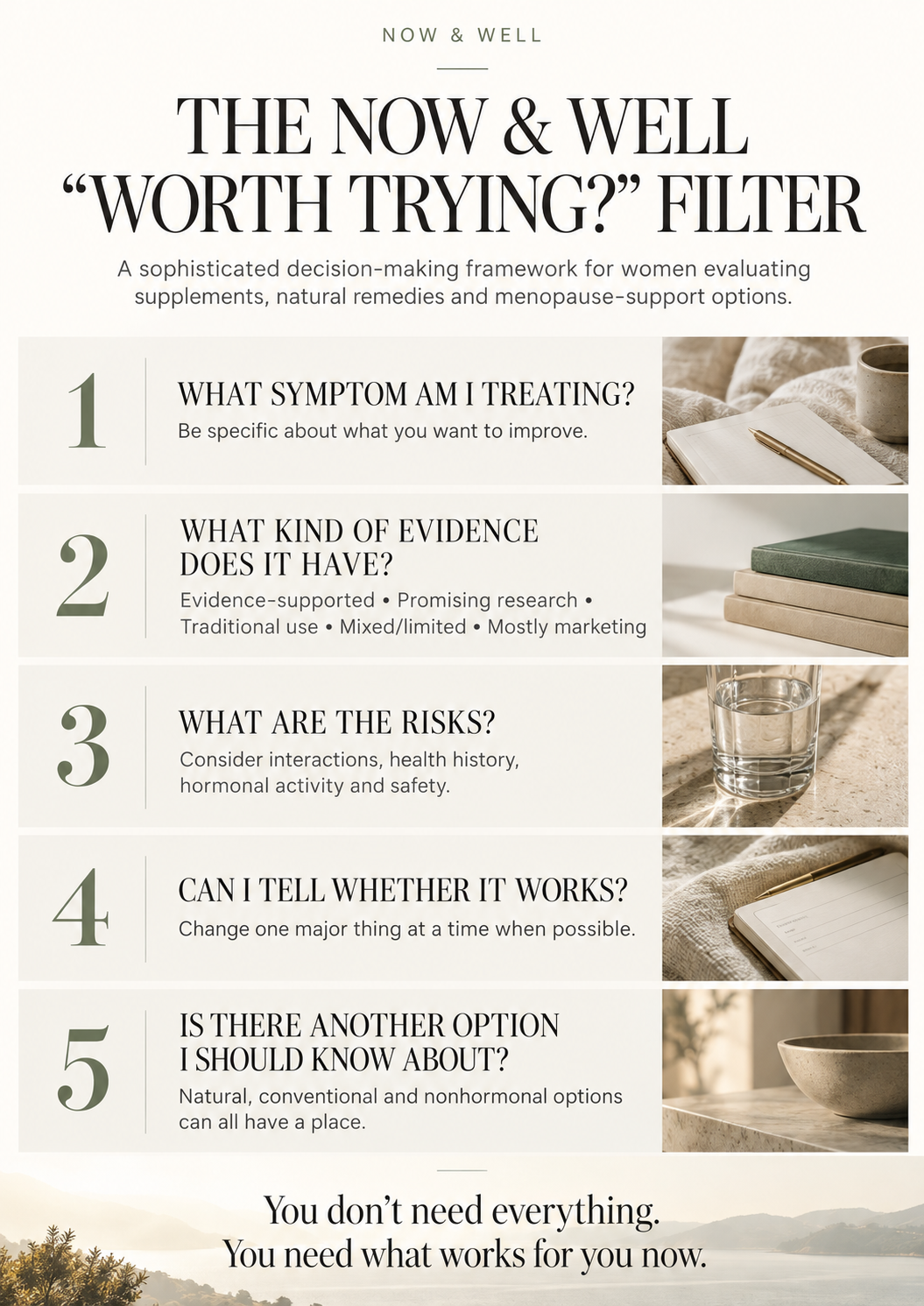
The Now & Well “Worth Trying?” Filter
Before I add a menopause supplement—or really any wellness product—to my routine, these are the questions I want answered.
What is it supposed to help?
Be specific.
“Supports women during menopause” tells me almost nothing.
“Studied for hot-flash frequency” is much more useful.
What kind of evidence does it have?
There is a big difference between:
- evidence-supported,
- promising human research,
- traditional use,
- mixed or limited evidence, and
- mostly marketing.
Those categories should not be presented as though they are interchangeable.
What are the risks?
Does it interact with medications?
Does it have hormonal activity?
Is there a liver concern?
Could it affect bleeding?
Is the ingredient appropriate for your health history?
Will you be able to tell whether it works?
This one is underrated.
If you start black cohosh, magnesium, ashwagandha, three new vitamins, a sleep drink and an entirely new diet on Monday, what exactly helped when you feel better three weeks later?
Or what caused the problem if you feel worse?
Change one thing at a time when possible.
Is there a better-established option?
Preferring a natural approach should never mean being denied accurate information about treatments with stronger evidence.
You can still decide no.
But you deserve to know what the alternatives actually are.
Black Cohosh: Worth Considering, With Caveats
Black cohosh is probably one of the best-known herbal remedies for menopause.
It also happens to be one that helped me.
I noticed an improvement in my hot flashes while using it.
But black cohosh is a perfect example of why menopause research requires nuance.
NCCIH notes that a substantial number of studies have evaluated black cohosh for menopause symptoms. A 2023 review of 22 studies of products containing black cohosh extract found potential benefit for overall menopause symptoms and improvement in hot flashes, although research across different products has not been consistent.
So is black cohosh “proven”?
I would not use that word.
But I also would not say there is nothing behind it.
The more accurate answer is:
There is meaningful research suggesting benefit, but results vary depending on the extract, product, dose, study design and population.
That is very different from dismissing it.
What about safety?
Black cohosh has generally been well tolerated in studies lasting up to a year. Rare cases of serious liver injury have been reported in people using products labeled as black cohosh, although it has not been established that black cohosh itself caused all of those cases. NCCIH also notes that some commercial products have contained the wrong herb or undeclared mixtures.
Product quality matters.
So does your individual health history.
Now & Well Bottom Line
Black cohosh helped me personally, and I think it has enough research and traditional use behind it to be taken seriously. But it is not guaranteed to work for every woman, and quality and safety still matter.
Ashwagandha: Promising, but We Need More Research
Ashwagandha has become one of those ingredients that seems to appear everywhere lately.
Stress gummies.
Sleep formulas.
Hormone blends.
Menopause supplements.
That usually makes me a little suspicious—not because the ingredient is necessarily useless, but because when one botanical suddenly claims to help everything from anxiety to metabolism to hormones to your inbox, marketing has probably gotten involved somewhere.
There is, however, some interesting menopause-specific research.
A randomized, double-blind, placebo-controlled study involving 100 perimenopausal women tested 300 mg of ashwagandha root extract twice daily for eight weeks. Women receiving ashwagandha had significant improvements in menopause symptom scores and menopause-related quality-of-life measures compared with placebo. Ninety-one women completed the study.
That is encouraging.
But it is still one relatively small, short-term study.
So I would not jump from that to:
“Ashwagandha treats menopause.”
Now & Well Bottom Line
Promising human evidence, but still limited. Worth considering when the symptoms you are trying to address overlap with what has actually been studied. Not a magic “hormone balancer.”
Soy and Isoflavones: Maybe Helpful, but Keep Expectations Reasonable
Soy gets discussed endlessly in menopause conversations because it contains isoflavones—plant compounds with estrogen-like activity.
NCCIH says soy isoflavone supplements or soy protein may help reduce the frequency and severity of hot flashes, but the effect may be small.
That does not make soy useless.
And it does not mean every woman will notice a difference.
It means this is one of those areas where:
possible benefit is a more honest phrase than solution.
There is also an important distinction between eating soy foods such as tofu, tempeh or edamame and taking concentrated isoflavone supplements.
They are not automatically equivalent.
Now & Well Bottom Line
Soy foods can absolutely fit into a healthy diet, and soy or isoflavones may offer modest symptom support for some women. Just keep your expectations realistic.
What About Chasteberry, Maca and All the Other Herbs?
This is where supplement labels can become exhausting.
Chasteberry, or Vitex, has a long history of use in women’s health and appears in some menopause formulas.
Maca is another popular ingredient, particularly in products aimed at energy, sexual wellness and menopause support.
Then there is red clover, dong quai, wild yam, evening primrose and many others.
Some have traditional use.
Some have small or mixed studies.
Some may turn out to be more useful than the current research suggests.
But that does not mean all of them deserve equal billing—or equal space in your medicine cabinet.
My preference is not to turn a menopause routine into an herb collection.
Start with the symptom.
Then look for the options with the best combination of: traditional use, human research, plausible benefit and acceptable safety.
You can always explore further if that first step is not enough.
Vaginal Dryness Deserves Its Own Conversation
We need to talk about this more openly.
Because vaginal dryness is not simply an inconvenience women are expected to quietly accept after 50.
And while women often call it “dryness down there,” the larger medical condition can be genitourinary syndrome of menopause, or GSM.
GSM can include:
- vaginal dryness
- burning
- irritation
- pain with intercourse
- urinary symptoms
Hormone therapy—including local vaginal estrogen—is an established treatment option for GSM.
But hormones are not the only option.
Vaginal Moisturizers and Lubricants
These do different jobs.
A lubricant is typically used around sexual activity to reduce friction.
A vaginal moisturizer is generally used on a regular schedule to help improve ongoing moisture and comfort.
Women sometimes buy one expecting it to behave like the other.
Knowing the difference can save a lot of frustration.
Vaginal Hyaluronic Acid Is Genuinely Interesting
We already know hyaluronic acid as a water-binding ingredient in skincare.
It is also being studied for vaginal dryness and other GSM symptoms.
A 2024 randomized pilot trial compared a vaginal hyaluronic-acid suppository with vaginal estrogen cream in women with GSM. After 12 weeks, symptoms improved in both groups, and researchers found no clinically meaningful difference between the groups in the study’s primary symptom score. Forty-five women provided data at the 12-week point, so this was still a relatively small pilot study.
That means I would not say hyaluronic acid has been proven equal to estrogen.
I would say:
It is a promising nonhormonal option with human clinical evidence.
That is worth knowing.
My Experience With O Positiv
I’ve also personally used O Positiv menopause-support products.
For me, I noticed fewer hot flashes and improvement in vaginal dryness.
Again, that is my personal experience.
I don’t want you buying something simply because it helped me.
What interests me is looking at the product in the same way I want us to look at everything else:
- What is in it?
- Why is it there?
- What do we know about those ingredients?
- What is based on research?
- What is based on traditional use?
- And what is primarily a manufacturer claim?
That is how I want Now & Well recommendations to work.
I can tell you:
This helped me.
But that is different from saying:
This is guaranteed to work for you.
Those are not the same statement.
And I never want them to become the same statement here.
Natural Support Doesn’t Always Mean Something You Swallow
When we talk about natural support during perimenopause and menopause, supplements tend to get most of the attention.
But taking care of yourself naturally can include much more than what comes in a bottle.
Stress, poor sleep and feeling constantly overstimulated can make an already difficult season feel much harder.
That does not mean stress is the cause of every menopause symptom.
And I am certainly not going to tell a woman having significant hot flashes that she just needs to “relax.”
But finding ways to create more calm in your life can still matter.
And that can look different for every woman.
For me, natural wellness can include things as simple as:
- taking quiet time away from constant noise and screens
- prayer
- reading and studying the Bible
- journaling
- reading something that settles your mind
- spending time outside
- taking a walk
- listening to music
- breathing slowly for a few minutes
- protecting your sleep routine
- spending time with people who make you feel grounded
- simply allowing yourself a little time to be still
You do not have to adopt someone else’s wellness ritual because it is popular.
The goal is to find practices that genuinely help you slow down, sleep better, manage stress and feel more grounded.
And these practices do not have to replace medical treatment or supplements when those are needed.
They are part of the bigger picture of taking care of yourself well.
Now & Well Bottom Line
Natural support is not only about herbs and supplements. Sometimes it is also about creating enough quiet in your life to hear what your body—and perhaps your spirit—has been trying to tell you.

What I Wouldn’t Spend My Money On First
This may be one of the most important sections in this article.
Because midlife women are being marketed to aggressively.
If the product promises to:
- balance your hormones,
- fix your metabolism,
- restore libido,
- eliminate hot flashes,
- improve sleep,
- lift your mood,
- sharpen your memory,
- flatten your belly,
- and make you feel 25 again...
...all before breakfast...
I would like us to slow down.
I am particularly cautious about products that hide everything inside a giant proprietary blend without clearly telling you how much of each ingredient you are getting.
I am cautious about the phrase “hormone balancing” when the company never clearly explains what hormone, what measurement, what mechanism or what evidence it is referring to.
I am cautious when testimonials are treated like clinical trials.
And I am cautious when a company makes you feel afraid of normal aging in order to sell the solution.
Good marketing can make almost anything sound essential.
That does not make it essential.
What Does It Mean When a Supplement Isn’t FDA Approved?
This is an area where wording matters.
Dietary supplements are regulated differently from prescription and over-the-counter medications in the United States.
Under current law, FDA is not authorized to approve dietary supplements for safety and effectiveness before they are marketed in the same way it reviews and approves new drugs. Supplement companies are responsible for ensuring their products meet applicable safety and labeling requirements.
But that does not automatically mean a supplement is bad.
It does not mean the ingredient does not work.
And it certainly does not mean that a natural remedy with generations—or even centuries—of traditional use should automatically be dismissed because it has not gone through a pharmaceutical-drug approval process.
At the same time, traditional use alone is not proof that something is effective or safe for everyone.
This is where we need balance.
Some natural ingredients have substantial research.
Some have promising early human studies.
Some have a long history of traditional use but relatively little modern clinical research.
And some products simply have excellent marketing.
The job is to know which is which.
The regulatory distinction tells us something about how the product reaches the marketplace.
It does not, by itself, tell us whether the ingredient works.
FDA itself notes that dietary supplements can play a role in comprehensive care and can help improve or maintain health or provide needed nutrients, while also advising consumers to consider safety and possible interactions.
So when I am evaluating a supplement, I do not ask only:
“Is this FDA approved?”
I ask:
- What is actually in it?
- How much is in it?
- Has this ingredient been studied?
- How has it traditionally been used?
- Is the manufacturer transparent?
- Are there known safety concerns or medication interactions?
- Does the claim being made match the evidence we actually have?
That is a much more useful filter.
Now & Well Bottom Line
FDA approval is not the only measure of whether something may be useful. But “natural” and “sold as a supplement” are not proof either. We look at the whole picture.
What About Hormone Therapy?
We cannot have an honest conversation about menopause relief without talking about hormone therapy.
And we should not frame it as the enemy of natural health.
Hormone therapy remains the most effective treatment for bothersome hot flashes and night sweats and is also used for GSM, including vaginal dryness.
Does that mean every woman should use it?
No.
Health history matters.
Timing matters.
Risk factors matter.
Symptoms matter.
Preference matters.
But women deserve accurate information about what exists.
You can prefer natural options and still deserve to understand conventional ones.
You can use hormone therapy and still care deeply about nutrition, herbs, prayer, stress reduction and other aspects of wellness.
And you can decide that hormone therapy is not right for you without pretending that it cannot help anyone.
Midlife wellness does not require joining a camp.
What If I Don’t Want Hormones—but Natural Remedies Aren’t Enough?
The choice is not: Hormones OR herbs.
There are prescription nonhormonal treatments for hot flashes too.
FDA-approved nonhormonal prescription options include low-dose paroxetine and fezolinetant. Certain other medications—including some antidepressants, gabapentin and oxybutynin—may also be used off-label when appropriate.
I am not suggesting which medication anyone should take.
I am pointing out that women have more choices than many of us realize.
If your hot flashes are disrupting your sleep, work, mood or quality of life and the natural approach you tried is not helping enough, that does not mean you failed.
It means there are other options to discuss.
A Word About Mixing Supplements
One of the easiest ways to lose track of what you are doing is to start stacking products.
A menopause formula.
Plus black cohosh.
Plus ashwagandha.
Plus magnesium.
Plus something for sleep.
Plus another product for libido.
Now we may have duplicated ingredients, higher total amounts than you realize and a greater possibility of interactions.
Discuss supplement use with a doctor, pharmacist or other qualified healthcare professional because supplements can interact with medicines and with other supplements.
This becomes especially important if you take prescription medication, have liver disease, have a hormone-sensitive medical history, take medications that affect bleeding, or have other significant health conditions.
And if you develop new vaginal bleeding after menopause, do not assume it is simply another normal hormonal fluctuation.
That deserves medical evaluation.
How I Would Try Something New
If I were trying a new menopause supplement today, I would keep it simple.
First, I would decide which symptom I am actually trying to change.
Then I would write down what that symptom looks like before starting.
How many hot flashes am I having?
How often am I waking?
How uncomfortable is the dryness?
How much is this interfering with my day?
Then I would change one major thing at a time whenever possible.
Not because life is a clinical trial.
Because otherwise we can spend hundreds of dollars and still have absolutely no idea what helped.
Give yourself a reasonable observation period based on the intervention and guidance you are using.
Then ask:
Is this actually improving my life enough to keep using it?
Not:
I already bought three bottles, so I guess I’m committed now.
What Has Helped Me Personally
I want to be very clear about this part because lived experience matters to me.
Black cohosh was helpful for my hot flashes.
I’ve also used O Positiv menopause-support products, and I personally noticed a reduction in hot flashes and improvement in vaginal dryness.
Those experiences influence what I am interested in.
They do not change the level of scientific evidence.
I think both things can be true at once:
A natural product can genuinely help me.
And:
We can still be honest that research is mixed or incomplete.
I do not need science to invalidate what I experienced.
And I do not need my experience to pretend the science is stronger than it is.
That is the balance I want here.
The Bottom Line
I do not think women should have to choose between blindly buying supplements and being told that nothing natural is worth trying.
That is another false choice.
Some natural approaches have legitimate research behind them.
Some have promising early evidence.
Some have extensive traditional use but limited modern clinical research.
Some help one woman and do absolutely nothing for another.
And some are mostly very good marketing.
So before you buy another menopause product, come back to the filter:
What symptom am I treating?
What kind of evidence does this option have?
What are the risks?
Can I tell whether it is actually helping?
Is there another option I should at least know about?
Natural remedies can have a place.
Hormone therapy can have a place.
Nonhormonal medication can have a place.
Faith, quiet time, movement, good nutrition and other forms of self-care can have a place.
Sometimes more than one approach belongs in the same plan.
The point is not to be perfectly “natural.”
The point is to make informed decisions about your body, your symptoms and your life now.
Because you don’t need everything.
You need what works for you now.
Read Next: Is Menopause Changing Your Skin Too?
If your face has become suddenly dry, tight or uncomfortable—even though you are moisturizing—read Why Is My Skin So Dry in Menopause — Even When I Moisturize?.
It explains what menopause may change in the skin, why moisturizer sometimes is not enough, and how to troubleshoot your routine before buying another product.