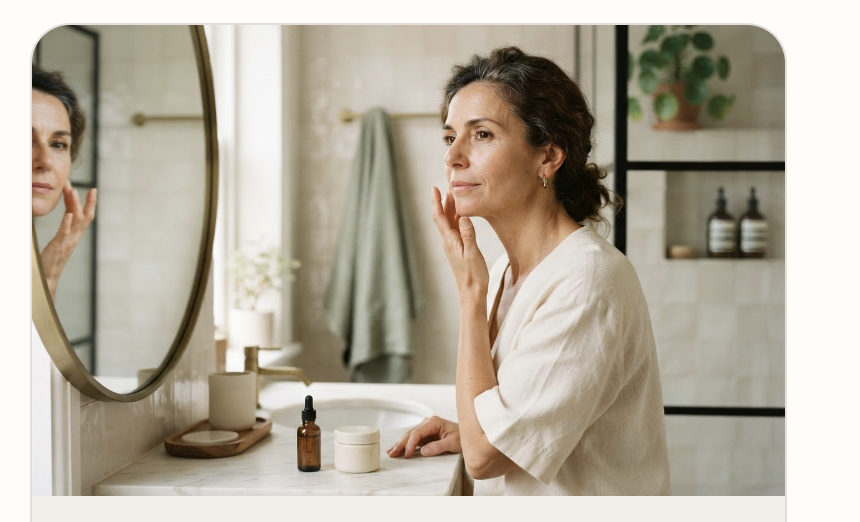
You moisturize in the morning.
Maybe again before bed.
You bought the hydrating serum. You switched to the richer cream. You are drinking your water. You may even have a little collection of half-used moisturizers sitting on the bathroom counter because surely one of these things should work.
And yet your skin can still feel tight by lunchtime.
Your cheeks may suddenly look rough. Makeup catches on little flakes that weren’t there before. Products you’ve used for years start to sting. Or perhaps your skin simply feels...different.
If you’re in your 40s, 50s or 60s, menopause may be part of the reason.
But it isn’t necessarily the whole reason.
One of the biggest mistakes we can make with midlife skin is blaming every change on hormones and then trying to solve it by buying a product labeled “menopause skin.”
Sometimes your skin doesn’t need another moisturizer.
It needs us to figure out why it is losing moisture in the first place.
Does Menopause Really Make Your Skin Drier?
Yes, it can.
As estrogen declines during the menopause transition, several things that influence the way skin looks and functions can change. Research has associated lower estrogen with reduced skin moisture, changes in barrier function, decreased collagen and elasticity, thinning and increased dryness. Dermatologists also recognize dry skin as a common change during menopause.
But I want to emphasize the word can.
Menopause doesn’t happen in a vacuum.
At the same time hormones are changing, our skin is also experiencing chronological aging, years of cumulative environmental exposure, seasonal weather changes, medications, new health conditions and—sometimes—a skincare routine that is simply doing too much.
That means the answer isn’t always:
“Estrogen dropped, so now your skin is dry.”
A better question is:
What has changed about my skin’s ability to hold onto moisture—and is anything in my routine making that harder?
If your entire complexion suddenly seems unfamiliar, you may also want to read My Skin Changed. Now What?. That’s really where this conversation begins.
Dry, Dehydrated and Barrier-Impaired Are Not Exactly the Same Thing
These words get thrown around constantly in skincare, often as though they mean the same thing.
They don’t.
Dry skin generally describes skin that isn’t maintaining enough of the water and lipids needed for a smooth, comfortable outer layer. It may feel rough, tight, flaky or itchy.
Dehydrated skin is a common cosmetic term for skin that has insufficient water in its outermost layers. Even skin that still produces oil can feel dehydrated.
Barrier-impaired skin means the outer protective layer of the skin isn’t doing its job as effectively as it should. Water can escape more easily, and irritants can get in more easily.
These can overlap.
In fact, they often do.
Think of your skin barrier like the roof of a house.
Water is what you’re trying to keep inside.
You can keep carrying buckets of water into the house all day long, but if the roof is leaking faster than you’re replacing it, the real problem isn’t your supply of buckets.
Your moisturizer may not be underperforming. It may simply be outnumbered.
Dry vs. Dehydrated vs. Barrier-Impaired
Dry
- Rough
- Flaky
- Tight
- May lack softness
Dehydrated
- Feels tight
- Can look crepey
- May occur even when skin still produces oil
Barrier-impaired
- Stinging
- Burning
- Reactive
- Flaky
- Unusually sensitive
Why Am I Still Dry If I Moisturize Every Day?
This is the question I think we need to spend more time answering.
Because buying a richer cream may help—but if you’re continuing to strip, irritate or dehydrate your skin every day, the cream is being asked to clean up after the rest of your routine.
Here are some of the most common reasons.
Your cleanser may be removing too much
That squeaky-clean feeling?
I’m not a fan.
A cleanser’s job is to remove what needs to be removed without leaving the skin feeling as though it has been degreased for industrial use.
As skin becomes drier or more reactive in midlife, a cleanser that worked beautifully for years may suddenly feel too aggressive.
The American Academy of Dermatology specifically recommends mild cleansers rather than drying soaps for menopausal skin.
Some women may also find that they don’t need a full facial cleanse twice a day. A gentle morning rinse may be enough, depending on your skin and what you’ve applied overnight.
Your skin gets a vote.
You may still be treating the skin you had at 35
This is a big one.
You may have spent years using:
a foaming cleanser, exfoliating toner, vitamin C, glycolic acid, retinoid, scrub and maybe a little something else because Instagram told you it was essential.
And perhaps your skin tolerated all of it.
Until it didn’t.
Retinoids, alpha-hydroxy acids, beta-hydroxy acids, benzoyl peroxide and exfoliating products can all be useful.
They can also contribute to irritation and dryness when your skin’s tolerance changes — and if you’re also dealing with breakouts on top of the dryness, that combination has its own piece here.
This doesn’t mean women over 50 should throw away their retinoids.
It means the routine may need to change even when the ingredient is still good.
Less often may work better.
A gentler formulation may work better.
And sometimes your barrier needs a short break before you introduce treatment products again.
The goal isn’t to win an award for the most active ingredients used before breakfast.
The goal is healthy skin.
Your moisturizer may simply be too light now
There is a real difference between gels, lotions, creams and ointments.
As a general rule, creams contain more oil than lotions, while ointments are more occlusive and tend to hold moisture in more effectively.
That doesn’t mean everybody needs to coat her face in petroleum jelly.
It means the feather-light gel that was perfect at 38 may no longer be enough at 52.
And that’s okay.
Your skin didn’t fail.
Its requirements changed.
Your environment—and very hot showers—may be pulling moisture from your skin
Cold outdoor air.
Indoor heating.
Air conditioning.
Low humidity.
Wind.
Very hot showers.
All of these can influence how quickly skin loses water.
Very hot water can also strip away some of the surface lipids that help your skin hold onto moisture, which is especially unhelpful if your barrier is already feeling dry, tight or irritated.
You do not need to switch to freezing showers.
Warm water is fine.
The goal is simply to avoid turning every shower into a steam-room session when your skin is already struggling to stay comfortable.
A humidifier may also help some women during especially dry seasons, particularly in heated bedrooms.
Climate matters.
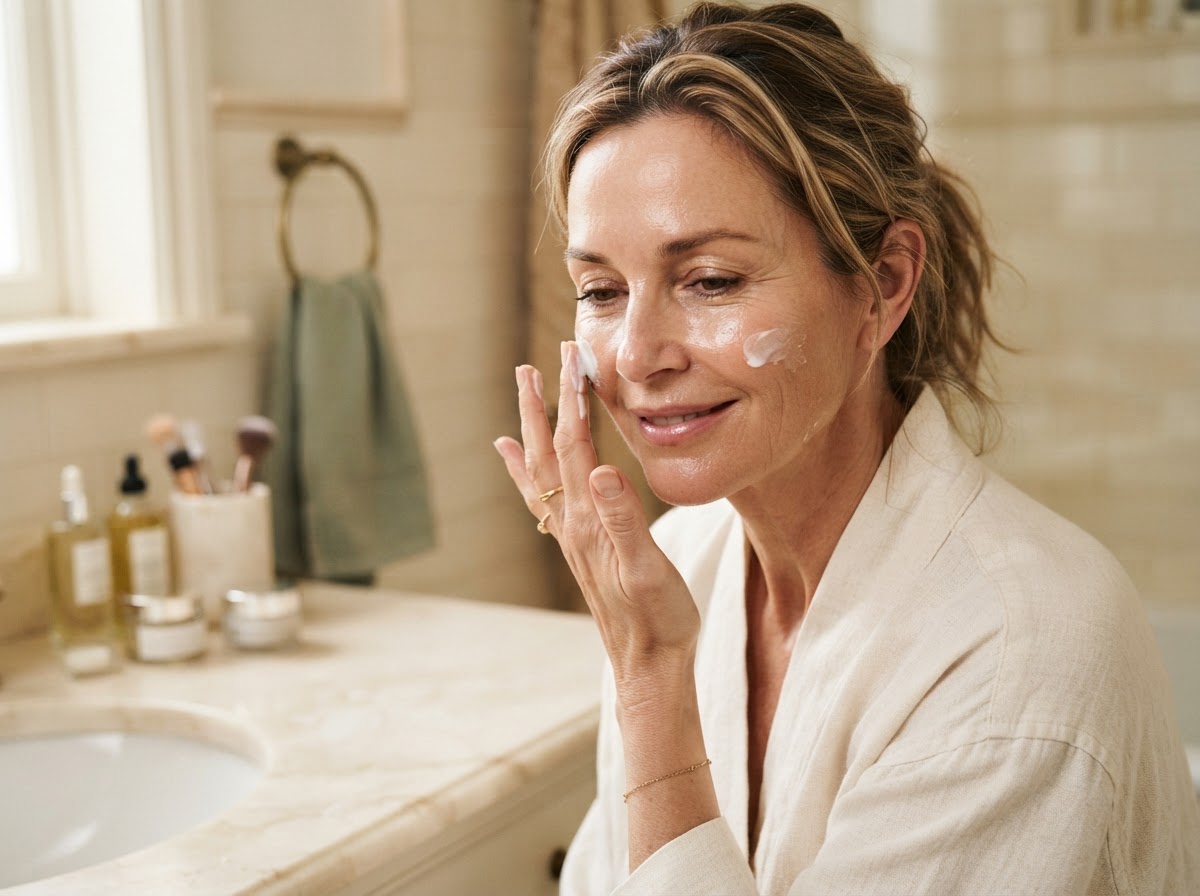
The Now & Well Moisture Trio
One of the easiest ways to understand moisturizers is to stop treating “hydrating” as though it were one job.
A good moisture strategy often involves three different jobs.
1. Humectants: Bring Water Into the Conversation
Humectants help attract and hold water in the outer layers of the skin.
Common examples include:
- glycerin
- hyaluronic acid
- urea
Hyaluronic acid gets most of the beauty industry’s attention, but glycerin deserves far more respect than it usually gets.
It has been used effectively in moisturizers for a very long time.
The important point is this:
A humectant is not an entire moisturizer.
If you’re applying a hyaluronic-acid serum and still feeling dry, it doesn’t automatically mean hyaluronic acid “doesn’t work.”
You may simply need more support around it.
2. Emollients: Smooth and Replenish
Emollients help soften rough skin and fill some of the spaces between skin cells.
Examples can include:
- ceramides
- fatty acids
- squalane
- shea-derived lipids
- certain plant oils
Ceramides are particularly interesting because ceramides are naturally part of the skin’s barrier structure.
For women dealing with increased dryness or sensitivity, looking for a well-formulated moisturizer containing ceramides can make much more sense than buying another trendy serum.
3. Occlusives: Help Keep Water From Escaping
Occlusives create a protective layer that reduces water loss.
Examples include:
- petrolatum
- dimethicone
And yes, I know petrolatum isn’t glamorous.
It doesn’t come from a rare flower harvested under a full moon.
It is, however, very good at reducing water loss.
You don’t necessarily need heavy occlusion over your entire face.
Sometimes adding a little more protection only to the driest areas is enough.
Hydration isn’t one ingredient. It’s a system.
The Now & Well Moisture Trio
Humectant
Helps attract and hold water
Examples
- Glycerin
- Hyaluronic acid
- Urea
Emollient
Helps soften and replenish
Examples
- Ceramides
- Squalane
- Fatty acids
- Selected plant oils
Occlusive
Helps slow moisture loss
Examples
- Petrolatum
- Dimethicone
- Richer creams or ointments
Before You Buy Anything: Do the Midlife Moisture Check
Before another cream comes home with you, I want you to look at four things.
Are you STRIPPING?
Look at your cleanser, water temperature, scrubs, cleansing brushes and how often you wash.
Does your face feel tight after cleansing?
That’s information.
Are you IRRITATING?
Look at the total routine—not each product individually.
A retinoid may be fine.
An exfoliating acid may be fine.
Vitamin C may be fine.
But retinoid + acid toner + scrub + strong cleanser + another exfoliating serum may be an entirely different story.
Are you REPLACING?
Are you actually giving the skin water-binding ingredients and barrier-supportive lipids?
Or are most of your products “treatment” products?
Are you SEALING?
Is your moisturizer rich enough for your current skin, your current environment and your current level of dryness?
Sometimes the missing step isn’t another serum.
It’s keeping the moisture you already added from leaving.
The Midlife Moisture Check
Stripping
Irritating
Replacing
Sealing
KEEP. PAUSE. REPLACE.
This is one of my favorite ways to simplify a routine when your skin starts misbehaving.
KEEP
What still works and feels good.
PAUSE
What may need a temporary timeout while you figure things out.
REPLACE
What genuinely no longer fits your skin’s needs.
KEEP: The things that are working and aren’t causing irritation.
A gentle cleanser.
A comfortable moisturizer.
Sunscreen.
Don’t dismantle the entire bathroom cabinet because your cheeks got dry.
PAUSE: Anything that may be aggravating irritated skin.
That may include exfoliating acids, scrubs or a retinoid for a short period if they’re currently causing burning, peeling or significant discomfort.
REPLACE: Products that clearly no longer suit the skin you have now.
Maybe your cleanser is too strong.
Maybe your lotion needs to become a cream.
Maybe you don’t need three exfoliants.
And then give your skin enough time to tell you whether the changes are helping.
We sometimes change six things in three days and then wonder which one worked.
Your skin cannot submit a useful performance review under those conditions.
What Ingredients Are Actually Worth Looking For?
You don’t need to memorize an ingredient dictionary.
For persistent dryness, I’d pay more attention to a few useful categories than to whatever ingredient is currently trending.
Glycerin can help attract and retain water.
Ceramides can help support the barrier.
Hyaluronic acid can be a useful humectant, particularly when paired with a moisturizer that provides enough emollient and occlusive support.
Urea, at appropriate moisturizing concentrations, can help hydrate and soften dry, rough skin.
Petrolatum and dimethicone can help reduce water loss.
And then there is one natural ingredient I think deserves more attention.
What About Natural Options?
Natural skincare is one of those subjects where people tend to choose teams.
Either everything from a plant is wonderful...
or anything that hasn’t been through a pharmaceutical clinical trial is dismissed.
I don’t find either position particularly useful.
Natural does not automatically mean safe.
Conventional does not automatically mean better.
We look at what has been traditionally used, what makes biological sense, what has actually been studied, what the safety concerns are—and then we make a reasonable decision.
Colloidal oatmeal: one of the better-supported natural choices
Colloidal oatmeal has a long history of topical use for dry and irritated skin, and this is one natural ingredient for which we have more than folklore.
Clinical studies have found benefits for xerosis and skin-barrier measures, and the FDA recognizes colloidal oatmeal as an OTC skin-protectant ingredient for specific uses involving irritation and itching.
Now & Well Bottom Line
Evidence-supported and very reasonable to consider in a moisturizer for dry, sensitive or easily irritated skin.
Sunflower seed oil: promising, but formulation still matters
Not all plant oils behave the same way on skin.
In a small controlled study of adults, sunflower seed oil preserved barrier integrity and improved hydration, while repeated topical olive-oil application reduced stratum-corneum integrity and caused mild redness.
That doesn’t mean a drop of olive oil touching your face is a dermatologic emergency.
It does mean I wouldn’t automatically recommend straight olive oil as the best treatment for widespread menopausal dryness—especially if the barrier is already irritated or you have eczema-prone skin.
Now & Well Bottom Line
Sunflower oil has promising human barrier evidence. Olive oil should not automatically be assumed to be better simply because it’s natural.
Jojoba: useful, but let’s not oversell it
Jojoba is technically a liquid wax rather than a typical plant oil.
It has a long history in cosmetic formulations, and dermatology literature describes potential anti-inflammatory and skin-conditioning properties.
But we don’t have strong clinical evidence showing that jojoba specifically treats menopausal facial dryness.
Now & Well Bottom Line
A reasonable emollient ingredient if your skin tolerates it; not a menopause treatment.
Shea butter and aloe vera
Both can be useful ingredients in well-formulated moisturizing products.
Shea butter provides rich emollient lipids, while aloe has a long history of topical use and some clinical research in dry-skin settings.
But I wouldn’t choose a moisturizer simply because “aloe” or “shea” is printed on the front.
The whole formula matters.
That is true of natural products too.
Do I Just Need to Drink More Water?
Maybe—but probably not for the reason Instagram told you.
Being appropriately hydrated is important for your health.
But if your skin barrier is losing water too quickly, drinking an extra gallon of water does not magically patch the barrier from inside.
If you’re genuinely dehydrated, correcting that matters.
But for ordinary menopausal dry skin, the more useful questions are often:
How am I cleansing?
What am I applying?
Am I irritating the barrier?
And am I keeping enough moisture in?
So drink your water.
You just don’t have to carry around a jug the size of a toddler to prove your commitment to skincare.
What About Hormone Therapy?
Because estrogen affects the skin, researchers have naturally looked at whether menopausal hormone therapy changes skin hydration, collagen, thickness and other characteristics.
Some studies have reported improvements in certain skin measures, while results for others have been inconsistent.
Current evidence is not strong enough to support using systemic hormone therapy solely for skin aging or skin quality.
That’s an important distinction.
Hormone therapy is an established treatment for certain menopausal symptoms—including bothersome hot flashes and genitourinary syndrome of menopause, which can include vaginal dryness—but those treatment decisions should be based on the woman’s overall symptoms, medical history, risks and preferences, not simply because her face feels dry.
I also know that many women want to explore natural and nonhormonal approaches to menopause symptoms.
I do too.
I’ve personally found some natural approaches helpful during this stage of my life, including black cohosh and products formulated for menopause support.
But personal experience is not the same thing as proof, and some natural products have much better evidence than others.
That’s a conversation worthy of its own article rather than a paragraph squeezed into a skincare story.
Coming to the Now & Well Journal
Natural Help for Perimenopause and Menopause: What’s Worth Trying?
We’ll look at the research, traditional use, safety and real-life experience—including options for hot flashes, vaginal dryness and other common symptoms.
When Dry Skin Isn’t Just “Menopause Skin”
Persistent dryness deserves attention when it isn’t improving.
Eczema, psoriasis, contact dermatitis and other skin conditions can cause significant dryness or itching.
Certain medications and medical conditions can also contribute.
So while menopause may explain part of the picture, don’t let the word menopause become a reason to ignore a new symptom.
See a qualified healthcare professional or dermatologist if your dryness is:
- persistent despite appropriate care
- intensely itchy
- painful
- cracking
- bleeding
- accompanied by a new or spreading rash
- becoming red, warm or swollen
- interfering with sleep
- changing significantly without an obvious explanation
Sometimes the smartest skincare decision is finding out whether you’re dealing with a skincare problem at all.

A Simple Routine for Dry Menopausal Skin
Your routine does not need twelve steps.
Morning
If your skin doesn’t need a full cleanse, consider a gentle rinse or very mild cleanser.
Apply any simple hydrating product you already know your skin tolerates.
Follow with a cream-based moisturizer appropriate for your level of dryness.
Finish with broad-spectrum SPF 30 or higher.
Evening
Cleanse gently.
If you’re using a retinoid or another treatment and your skin tolerates it, continue according to the schedule that works for you.
If your skin is actively burning, peeling or irritated, this may be a good time to discuss reducing frequency or temporarily simplifying the routine.
Apply moisturizer while the skin still has a little moisture in it.
If particular areas remain very dry, a small amount of a more occlusive product on those areas may help.
And if your skin is currently irritated?
For a week or two, boring may actually be beautiful.
Give the barrier a chance to settle before you start adding things again.
The Bottom Line
Menopause can absolutely contribute to dry skin.
But the solution isn’t necessarily buying a product with the word menopause printed across the jar.
Your skin’s ability to hold onto moisture can change.
Your oil production may change.
Your tolerance for certain products may change.
Your environment may change.
And your old routine may simply no longer match the skin you have now.
Before you add another bottle, ask yourself:
Am I stripping?
Am I irritating?
Am I replacing what my skin needs?
Am I sealing enough of that moisture in?
Then use Keep / Pause / Replace to simplify the decision.
Your skin didn’t suddenly become difficult.
Its needs may simply have changed.
And you don’t need everything.
You need what works for you now.