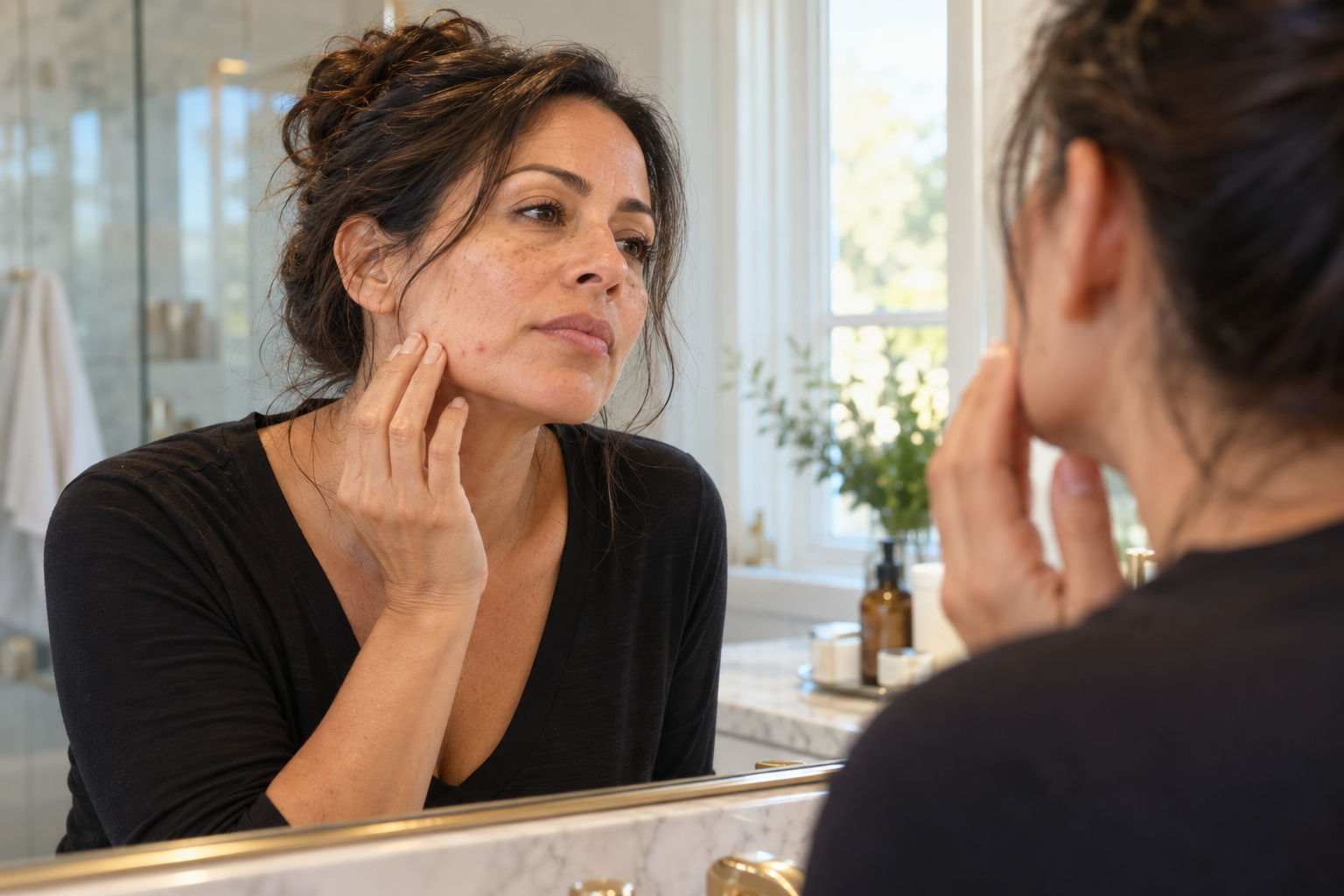
I’m in my late 50s.
My skin can be dry.
And yes, I still get breakouts.
At this point I feel like acne and I should have formally ended our relationship years ago, but apparently it renewed the lease.
If you are dealing with the same confusing combination—dry cheeks, sensitivity, maybe some flaking, and then a pimple deciding to set up camp on your chin—you are not imagining things. If your whole complexion suddenly feels unfamiliar, start here for the bigger picture on midlife skin changes.
And your skin is not malfunctioning because it apparently cannot decide whether it wants to be dry or acne-prone.
You absolutely can have dry skin and breakouts at the same time.
In fact, adult acne can continue into the 40s and 50s or appear for the first time in adulthood. The American Academy of Dermatology notes that adult-onset acne is especially common among women going through menopause and identifies fluctuating hormone levels during perimenopause and menopause as one possible contributor.
Meanwhile, declining estrogen and other changes associated with menopause can affect hydration, sebum production and skin-barrier function—which means the rest of your face may simultaneously be getting drier.
Welcome to midlife skincare, where apparently two opposite-sounding things can happen before breakfast.
But once you understand what may be going on, this gets much easier to approach.
First: Yes, Dry Skin and Acne Can Happen at the Same Time
One of the biggest misconceptions about acne is that it belongs exclusively to oily skin.
It doesn’t.
Acne develops within the hair follicle. Oil, dead skin cells, inflammation and bacteria can all play roles in the process.
Dryness, meanwhile, describes what is happening with your skin’s moisture and barrier.
Those systems interact, but they are not the same thing.
So it is entirely possible to have:
- dry or tight cheeks
- a sensitive forehead
- flaking around your nose
- and clogged pores or inflammatory pimples along your chin or jaw
You may also be using acne treatments that are contributing to the dryness.
Benzoyl peroxide, salicylic acid and topical retinoids can all cause dryness or irritation, which is one reason dermatologists may recommend moisturizer as part of an acne-treatment plan.
That gives us our first important Now & Well rule:
Don’t treat the breakout before you understand the rest of the skin.
Because if your entire strategy is:
PIMPLE! DRY EVERYTHING OUT!
...you may solve one problem by creating three more.
Why Am I Suddenly Breaking Out in My 40s, 50s—or Beyond?
Because acne did not sign a contract promising to leave after high school.
I wish it had.
Adult acne can continue well into the 40s and 50s, and some women develop it for the first time as adults. Hormonal fluctuations are one possible contributor, including those occurring during perimenopause and menopause.
But I want to be careful here.
Not every pimple you get after 45 is automatically “hormonal acne.”
Other possibilities can include:
- stress
- genetics
- skincare or haircare products
- medications
- dietary patterns, including frequent high-glycemic foods and highly processed foods, which may contribute to breakouts in some people
- friction or occlusion
- changes in your routine
- underlying medical conditions
- or simply adult acne behaving like adult acne
And no, one order of fries does not automatically explain the pimple on your chin.
But if your diet has shifted toward more sugar, refined carbohydrates, or highly processed foods and your skin changed around the same time, it may be worth paying attention to the pattern.
Food is not the sole cause of acne, and not everyone responds to the same foods in the same way.
AAD specifically identifies fluctuating hormones, stress, family history, certain products, medication side effects and sometimes underlying health conditions among possible contributors to adult acne.
That matters because when we call everything hormonal, we can accidentally stop asking useful questions.
For example:
Did this start after you added a new product?
Are you suddenly using a richer moisturizer everywhere because the rest of your face feels dry?
Did you begin using a new hair product that touches your jawline?
Has your diet changed significantly?
Are the bumps actually pimples—or could something else be happening?
Those are much more useful questions than automatically buying something labeled “menopause acne treatment.”
Why Is My Skin Getting Drier at the Same Time?
This is where midlife skin becomes particularly interesting.
Estrogen has important effects on the skin. Research reviews associate declining estrogen during menopause with changes in hydration, collagen, elasticity, barrier function and sebum production.
A recent review described inconsistent sebum production during perimenopause followed by greater reductions as hypoestrogenism progresses. It also described reductions in moisture retention and skin-barrier support.
Translated into normal-person language:
Your skin may not hold onto moisture the way it used to.
It may produce oil differently.
It may be more easily irritated.
It may tolerate products differently.
If the dryness itself is your main concern, I wrote a separate piece on why moisturizer alone can stop being enough.
And yes, you can still get a breakout while all of this is happening.
Because apparently midlife thought one skin concern at a time would be too easy.
Chronological aging matters too. Hormones are part of the story—not the entire story.
Climate, cleansing habits, sun exposure, medications and the products you put on your face can all affect how dry or irritated your skin feels.
Before You Treat It: Are Those Bumps Actually Acne?
This is something I want more women to consider before reaching for the benzoyl peroxide.
Not every red bump is acne.
Rosacea, folliculitis, perioral dermatitis and irritation can sometimes be described casually as “breakouts” because that is what they look like to us in the mirror.
And this distinction becomes especially important when your skin is suddenly behaving differently than it used to.
Ask yourself:
- Does it itch?
- Does it burn?
- Does it sting?
- Is the area persistently red?
- Are the bumps unusually uniform?
- Is this behaving differently from the acne you’ve had before?
- Is it worsening despite acne treatment?
If something looks or feels substantially different from your usual breakouts, that is a good reason to have a dermatologist evaluate it rather than continuing to experiment.
Research on menopause-related skin conditions also notes that hormone-responsive dermatoses such as acne and rosacea can behave variably around menopause and that significant gaps remain in understanding exactly how hormonal changes affect these conditions.
In other words:
Sometimes the correct skincare move is realizing this may not be a skincare-only problem.
The Biggest Mistake: Treating Midlife Breakouts Like Teenage Acne
You see a pimple.
You reach for the acne cleanser.
Then the salicylic acid.
Then maybe benzoyl peroxide.
Then the retinoid because you use that anyway.
Maybe an exfoliating toner while we’re here.
And somewhere around Wednesday your chin may look slightly better while the rest of your face feels like tissue paper.
Your entire face does not need to be punished because one pimple showed up.
Many effective acne ingredients can also be drying or irritating.
AAD advises that benzoyl peroxide can cause dryness, irritation or burning and recommends starting with lower concentrations such as 2.5% when appropriate to reduce side effects. Salicylic acid works by helping unclog pores and exfoliate, while retinoids are also well-established acne treatments but can contribute to irritation and dryness.
That doesn’t make these ingredients bad.
It means:
The fact that an ingredient works does not mean you need all of them on your face Tuesday night.
You do not get bonus points for making your skincare routine more aggressive.
The goal is the right treatment, not the most treatment.
PAUSE: Could Your Routine Be Making Both Problems Worse?
This is where I want you to step away from the shopping cart for a minute.
Before buying another acne product, look at what you are already using.
How many exfoliating products are in your routine?
You may have:
- an exfoliating cleanser
- salicylic acid
- an AHA serum
- exfoliating pads
- a retinoid
- and an occasional peel
Individually, each one may sound reasonable.
Together?
Your face may have opinions.
But I also don’t want to swing too far in the other direction and declare exfoliation the enemy.
Some women genuinely deal with surface buildup, clogged pores and rough texture that may benefit from thoughtful exfoliation.
The question isn’t:
“Is exfoliation bad for midlife skin?”
The question is:
“What does your skin need, and how often does it need it?”
Those are very different questions.
Does your cleanser leave your face tight?
That squeaky-clean feeling is not necessarily proof that your cleanser is doing an excellent job.
If your skin feels tight immediately after washing, pay attention.
Are you treating one breakout by treating your entire face?
A localized problem may not require a full-face assault.
Did you recently change several products at once?
If four things changed and your skin became unhappy, figuring out the culprit becomes unnecessarily difficult.
One change at a time may not be exciting.
It is, however, considerably easier to troubleshoot.
What About Moisturizer? Won’t It Make My Acne Worse?
Not automatically.
In fact, if your acne treatment is drying your skin, moisturizer may make the routine easier for your skin to tolerate.
AAD specifically recommends moisturizer for people whose acne treatments are causing dryness and notes that products labeled oil-free, non-comedogenic, won’t clog pores, or similar language are designed to be less likely to trigger acne.
But I don’t want to turn those words into magic either.
A product can say non-comedogenic and still not be the perfect moisturizer for you.
Texture matters.
Your climate matters.
The rest of your routine matters.
Your skin matters.
Some women with dry skin do better with creams. Other acne-prone women may prefer lighter gels or lotions. AAD’s moisturizer guidance also recognizes that combination skin may require a different approach in dry and oily areas.
There is no award for choosing the richest moisturizer.
There is also no award for making your skin survive on a whisper of gel because you are afraid of pores.
We are looking for comfortable, functional skin.
Which Acne Ingredients Actually Do What?
This is where skincare marketing can turn your bathroom cabinet into alphabet soup.
Let’s simplify it.
Benzoyl Peroxide
Benzoyl peroxide is a well-established acne treatment, particularly for inflammatory pimples.
But stronger is not automatically better.
AAD specifically suggests beginning with 2.5% when treating mild adult acne to help reduce dryness and irritation.
If your skin is already dry and sensitive, that matters.
Salicylic Acid
Salicylic acid is a beta-hydroxy acid that helps exfoliate and unclog pores.
AAD particularly points to it for blackheads and whiteheads.
That does not mean everyone needs it twice a day.
Frequency matters.
Formulation matters.
And what else you are using matters.
Azelaic Acid
Azelaic acid is particularly interesting in adult skin because it can help acne while also addressing post-acne dark marks. AAD includes it among effective over-the-counter adult-acne options.
It is also an ingredient dermatologists use for other conditions, which is another reason I would rather have persistent redness or acne-like bumps correctly identified than have someone self-treat indefinitely.
Retinoids
Retinoids have strong evidence in acne treatment and can also play a role in addressing visible signs of aging.
That combination makes them understandably appealing in midlife.
But tolerance still matters.
If the retinoid that worked beautifully for you five years ago now leaves your face persistently burning, peeling or uncomfortable, you are not required to win an endurance competition with your skincare.
You can reassess frequency, formulation and the rest of the routine with an appropriate professional.
And no—you probably do not need all four
I cannot emphasize this enough.
More active ingredients do not automatically equal more results.
Sometimes they equal a very expensive irritated face.
Which Acne Ingredient Does What?
Benzoyl Peroxide
Best known for: Inflammatory acne
Watch for: Dryness and irritation
Salicylic Acid
Best known for: Clogged pores, blackheads, whiteheads
Watch for: Over-exfoliation or dryness
Azelaic Acid
Best known for: Acne, inflammation and post-acne marks
Watch for: Individual tolerance
Retinoids
Best known for: Acne and cell-turnover support
Watch for: Dryness, peeling and irritation
The right ingredient depends on your skin, concern and tolerance.
What About Natural Options Like Tea Tree Oil or Lavender?
I also want to talk about this because not every woman wants conventional acne treatments as her first or only option.
I personally prefer natural approaches when they make sense for my skin.
But I also don’t believe something becomes automatically safe because it grew from the ground.
Plants are chemistry too.
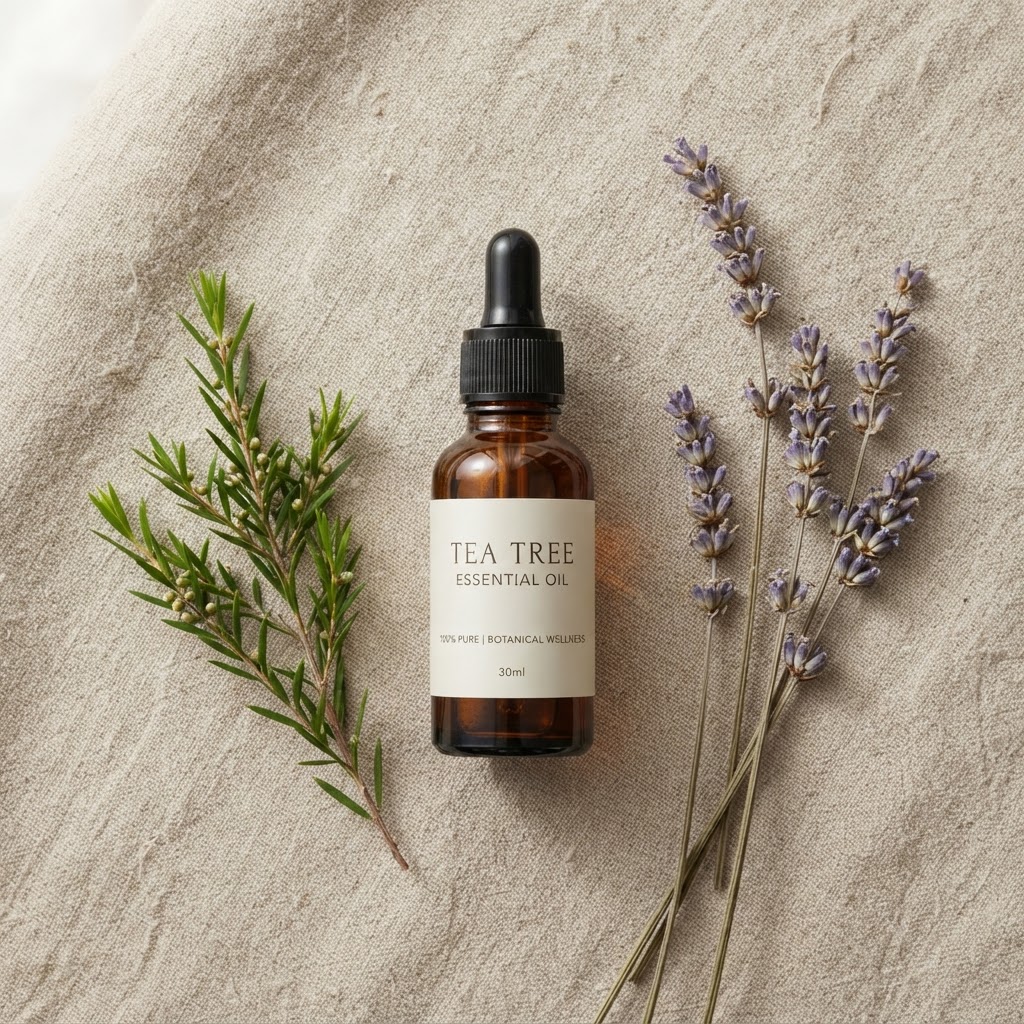
Tea Tree Oil
Of the natural acne ingredients, tea tree oil has some of the better human research behind it.
Tea tree oil comes from Melaleuca alternifolia, a plant native to Australia. NCCIH notes that Aboriginal Australians traditionally used tea tree leaves for wounds, burns and insect bites, and that a small amount of modern evidence suggests topical tea tree oil may be useful for acne—although more research is needed.
There are human trials as well.
A randomized, double-blind trial of 60 people found 5% tea tree oil gel significantly improved mild-to-moderate acne compared with placebo.
An older randomized comparison of 5% tea tree oil with 5% benzoyl peroxide found that both reduced inflammatory and non-inflammatory acne lesions. Tea tree acted more slowly but produced fewer side effects in that study.
More recently, a systematic review and meta-analysis including multiple studies found tea tree oil was associated with reduced acne severity, while reported adverse events were mostly local and mild. The researchers nevertheless emphasized that the clinical evidence remains limited and inconsistent.
So my takeaway is:
Tea tree oil is not just an internet folk remedy. There is some real acne research behind it. But that does not mean undiluted tea tree oil belongs directly on everyone’s face.
Tea tree can irritate or trigger allergic reactions. NCCIH advises that topical tea tree oil can cause irritation in some people.
Natural?
Yes.
Risk-free?
No.
Lavender Oil
Lavender is different.
There is interesting research around its potential anti-inflammatory and wound-healing properties, but we do not currently have the same level of clinical evidence supporting lavender as an acne treatment.
A review of lavender essential oil and wound healing identified human, animal and laboratory studies suggesting potential effects on healing, collagen expression and tissue remodeling. The authors also emphasized the need for standardized formulations and better-quality human trials.
A broader review of essential oils used for inflammatory skin conditions identified clinical literature involving acne, dermatitis, eczema, psoriasis and rosacea, but also highlighted important limitations in the available evidence.
So I would not tell you:
“Lavender treats acne.”
And I certainly would not tell you:
“Lavender treats rosacea.”
We don’t have strong enough clinical evidence to make those claims.
But I can tell you what I personally do.
What I Personally Use
I have personally used lavender essential oil diluted with virgin olive oil on occasional blemishes, and I have also used that combination on areas where my own rosacea tends to flare.
My skin has tolerated it well, and I feel it has helped me.
That is my experience.
It is not proof that the same combination will work for everyone.
And I think that distinction is important.
There are plenty of traditional and natural approaches that people have used successfully for generations despite having far less clinical research behind them than pharmaceutical ingredients.
Lack of research does not automatically mean something doesn’t work.
But longstanding use doesn’t automatically tell us that it will be safe or effective for every person either.
Both things can be true.
A Note About Olive Oil
The research around topical olive oil is actually a good example of why I don’t like absolutes.
One controlled study found that repeated topical olive-oil use reduced skin-barrier integrity and caused mild redness, while sunflower oil performed better for barrier preservation.
A newer randomized study of extra virgin olive oil on healthy adult forearm skin, however, found improvements in several measures of skin-barrier function, although petrolatum had stronger occlusive effects.
Those are different populations, methods and outcomes.
And neither study proves what olive oil will do on a rosacea-prone, acne-prone menopausal face.
Which brings me back to something I believe strongly:
My skin happens to tolerate olive oil. Yours may not. “Natural” is not a skin type.
If you want to explore an essential oil, don’t assume more is better.
Dilution matters.
Patch testing matters.
The condition of your skin matters.
And if you have rosacea, eczema, allergies or highly reactive skin, extra caution makes sense because topical lavender and other essential oils can trigger allergic skin reactions in some people.
We will explore traditional and natural skincare much more deeply in a separate Now & Well article because it deserves more than a paragraph squeezed between benzoyl peroxide and moisturizer.
The Now & Well Keep / Pause / Replace Approach
When you are dry and breaking out, my first instinct is not:
Buy everything new.
You already know that category doesn’t exist around here.
Instead:
KEEP
Keep the basics that are doing their jobs without causing trouble.
That might include:
- a gentle cleanser
- a moisturizer your skin likes
- sunscreen
- a treatment you clearly tolerate and benefit from
Do not break up a perfectly good skincare relationship because a new bottle appeared online looking attractive.
PAUSE
Temporarily step back from products that make it difficult to tell what your skin is doing.
Maybe that’s:
- an aggressive exfoliant
- multiple acne treatments at once
- a new serum
- daily use of something your skin no longer tolerates
- scrubs
- a treatment mask every other night
A pause isn’t necessarily a permanent breakup.
Sometimes you simply need enough quiet to hear what your skin has been trying to tell you.
REPLACE
Replace something when there is a reason.
Maybe your cleanser is too stripping.
Maybe the moisturizer you loved at 42 is not enough at 57.
Maybe a treatment is repeatedly irritating your skin.
Maybe your acne has changed enough that you need a dermatologist instead of another over-the-counter experiment.
Replace for a reason—not because the marketing department put “menopause” on a prettier jar.
The Now & Well
Keep / Pause / Replace Method
KEEP
What still works and feels good.
PAUSE
What may need a temporary timeout while you figure things out.
REPLACE
What genuinely no longer fits your skin’s needs.
A Simple Routine When You’re Dry AND Breaking Out
Please notice the word simple.
Not boring.
Not inadequate.
Simple.
Morning
Depending on your skin:
- Gentle cleanse—or sometimes simply rinse, if that genuinely works better for you.
- One appropriate treatment step if needed.
- Moisturizer.
- Broad-spectrum sunscreen.
That’s allowed.
There is no skincare authority waiting outside your bathroom to issue a citation because you don’t own seven serums.
Evening
- Remove makeup and sunscreen.
- Cleanse gently.
- Use the treatment strategy that actually addresses your concern.
- Moisturize.
If four products work for you, congratulations.
You do not need to turn them into nine.
And when you introduce something new, consider introducing one thing at a time.
That way, if your skin suddenly loves—or hates—it, you have a fighting chance of knowing why.
When the Answer Is a Dermatologist, Not Another Serum
Mild acne can often be treated with over-the-counter options.
But some situations deserve medical evaluation.
AAD recommends dermatologist care for large, painful, deep pimples or acne that scars, because over-the-counter products are unlikely to adequately treat those forms.
I would also want professional evaluation if you have:
- sudden severe acne
- persistent painful or cystic breakouts
- scarring
- a rash that looks like acne but burns or itches
- persistent redness
- sores that don’t heal
- rapidly changing skin
- breakouts that don’t respond to reasonable treatment
- significant changes after starting a medication
- other symptoms accompanying sudden acne
- or anything that simply doesn’t look right to you
And especially if you have been treating “acne” for months without success:
Let’s make sure it is actually acne.
Your bathroom cabinet cannot perform a biopsy.
Margarita’s Take: Really? We’re Still Doing This?
I have spent more than 25 years working with skin.
And I still occasionally look at a breakout on my own face and think:
Really? We’re still doing this?
Apparently professional credentials don’t exempt you from being personally offended by a chin pimple in your late 50s.
But living it myself has reinforced something I already knew professionally.
Skin changes.
What it tolerated ten years ago may not be what it tolerates now.
What worked beautifully at 35 may need adjusting at 55.
And the solution isn’t always stronger treatment.
Sometimes the smartest thing you can do is stop, look at the whole picture and ask:
What changed?
What am I already using?
What still works?
What might be irritating me?
What actually needs treatment?
And what can I leave alone?
That last question doesn’t get asked enough in skincare.
We have been trained to believe every skin concern requires another purchase.
Sometimes it does.
Sometimes it needs a different ingredient.
Sometimes it needs professional care.
Sometimes your routine needs simplifying.
And sometimes one angry little pimple is just one angry little pimple.
No emergency meeting required.
The Bottom Line
Dryness and breakouts can absolutely happen at the same time.
They are not opposites.
And experiencing both does not mean your skin has suddenly become impossible.
Adult acne can persist into your 40s and 50s, hormonal changes may contribute, and menopause can simultaneously affect hydration, oil production and skin-barrier function.
The trick is not to attack every breakout so aggressively that you make the rest of your skin miserable.
Look at the entire routine.
Keep what works.
Pause what may be complicating things.
Replace only what has a real reason to change.
And whether you prefer conventional ingredients, natural approaches, or a thoughtful combination of both, your skin gets the final vote.
Because you don’t need the most products.
You need what works for you now.