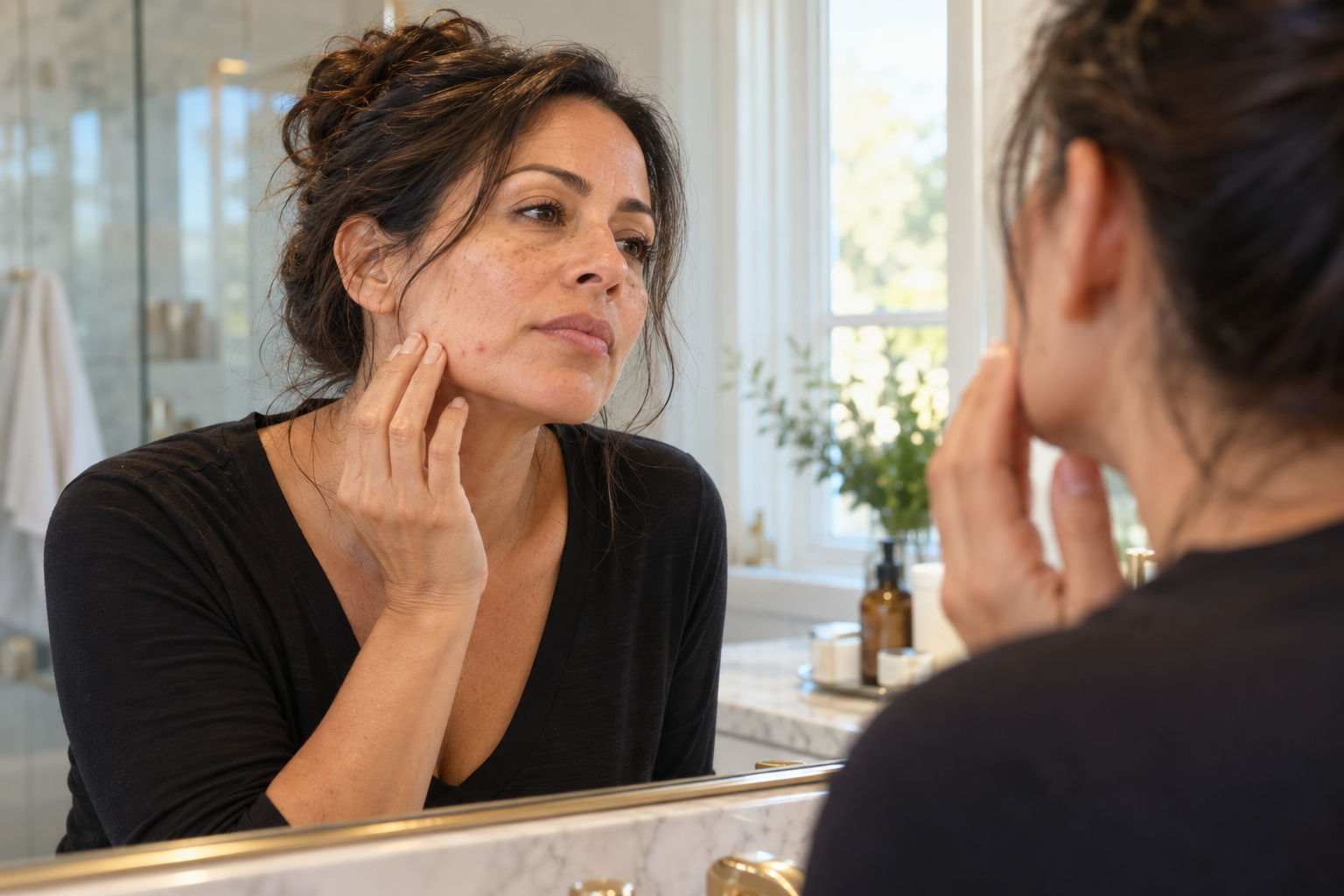
Your moisturizer suddenly isn’t enough.
The retinol you’ve used for years starts stinging.
Your cheeks feel dry, but somehow your chin has decided puberty deserved a sequel.
Makeup isn’t sitting the way it used to.
And that skincare routine you could practically do with your eyes closed suddenly feels like it belongs to somebody else.
If any of this sounds familiar, I want to start here:
You did not suddenly forget how to take care of your skin.
Your skin can change significantly during perimenopause, menopause, postmenopause, and simply as the years go by.
Hormonal changes can play a role, but so can sun exposure, medications, environment, your existing skincare routine, and the normal biological changes that happen as we age.
So before you panic, throw out everything in your bathroom, and order six new serums at 11:47 p.m., let’s talk about what may actually be happening.
Yes, Your Skin Really Can Change in Midlife
For some women, the changes are gradual.
For others, it feels like somebody flipped a switch.
And “midlife” doesn’t mean one exact age.
Some women begin noticing changes during perimenopause in their 40s.
Others notice them more around menopause or afterward in their 50s and 60s.
And women in their 60s can absolutely still be adjusting to skin that is drier, thinner, more easily irritated, breakout-prone, or simply different from the skin they remember having years ago.
It doesn’t work according to a convenient schedule.
I can personally attest to that.
I’m in my late 50s and I still get breakouts.
Yes. Breakouts.
At this point in life, I feel like acne and I should have formally parted ways years ago, but apparently nobody sent my chin the memo.
And that’s exactly why I don’t want Now & Well talking about midlife skin as if everything happens neatly in your 40s and then disappears.
For some women, skin changes start during perimenopause.
For others, they become more noticeable in their 50s.
And plenty of women are still dealing with dryness, sensitivity, breakouts, pigmentation, texture changes, and skin that seems to have developed its own personality well into their 60s.
There is no magical birthday where your skin says:
“Okay, we’re done with all that now.”
Wouldn’t that be convenient?
So, What Do Hormones Have to Do With It?
Quite a bit — but they’re not the entire story.
Estrogen affects several functions in the skin.
Research has associated declining estrogen during menopause with changes in collagen production, elasticity, hydration, thickness, and other structural and functional properties of the skin.
Translated out of research-paper language:
Your skin may not hold onto moisture the way it once did.
It may feel less plump.
It may become more easily irritated.
Fine lines may become more noticeable.
And products that once felt completely comfortable may suddenly feel like your face has filed a formal complaint.
Research examining menopause and skin physiology has also described changes involving collagen content, water content, elasticity, and skin thickness.
But here’s the part I don’t want us to oversimplify:
Not every change happening to your skin in midlife is automatically menopause.
Chronological aging matters.
Years of UV exposure matter.
Climate matters.
Medications can matter.
Skin conditions can develop or change.
And the products you’re using matter.
That’s why “menopause skincare” written across the front of a jar isn’t enough information for me.
Harvard Health has pointed out that some products marketed specifically as “menopause skincare” contain ingredients similar to conventional skincare products while carrying a higher price.
Their experts recommend looking at ingredients and your actual needs rather than assuming the menopause label automatically makes a product better.
You already know how I feel about that.
Your skin does not care what the marketing department named the moisturizer.
Putting “menopause,” “midlife,” “mature,” or “50+” on the front of a jar does not magically make what’s inside the right product for you.
Sometimes it may be a great product.
Sometimes it may be the exact same kind of formula you could buy without the very expensive reminder that you’re in menopause.
A label identifies a target market.
It does not diagnose your skin.
And it certainly does not guarantee that the product is what your skin actually needs.
That’s why I’d rather look at:
- What’s in it?
- What is it supposed to do?
- Does your skin need that?
- Is there evidence behind the ingredients?
- Are you already using something that does the same thing?
- Is this product actually better — or did someone simply change the packaging and add the word “menopause”?
Because those are two very different things.
Why Is My Skin Suddenly So Dry?
This is probably one of the most common complaints I hear — and live with.
You moisturize.
Your skin is still dry.
So you moisturize more.
And somehow, two hours later, your face acts as though it has never seen moisturizer in its life. If that sounds familiar, I wrote a whole piece on why moisturizer alone can stop being enough.
Declining estrogen can affect skin hydration, and age-related changes can also make skin more prone to dryness.
But before deciding your moisturizer is useless, look at the rest of your routine.
Are you using a cleanser that leaves your face feeling tight?
Are you exfoliating several times a week?
Retinol?
An exfoliating toner?
An acid serum?
An acne treatment?
And then maybe another serum because somebody said you needed that too?
Sometimes the problem isn’t simply:
“I need a heavier moisturizer.”
Sometimes it’s:
“My skin is losing moisture while the rest of my routine is making it harder for my skin to stay comfortable.”
That’s a very different problem.
Why Does Skincare I’ve Used for Years Suddenly Sting?
This one can feel especially confusing.
You haven’t changed the product.
So why is your skin suddenly objecting?
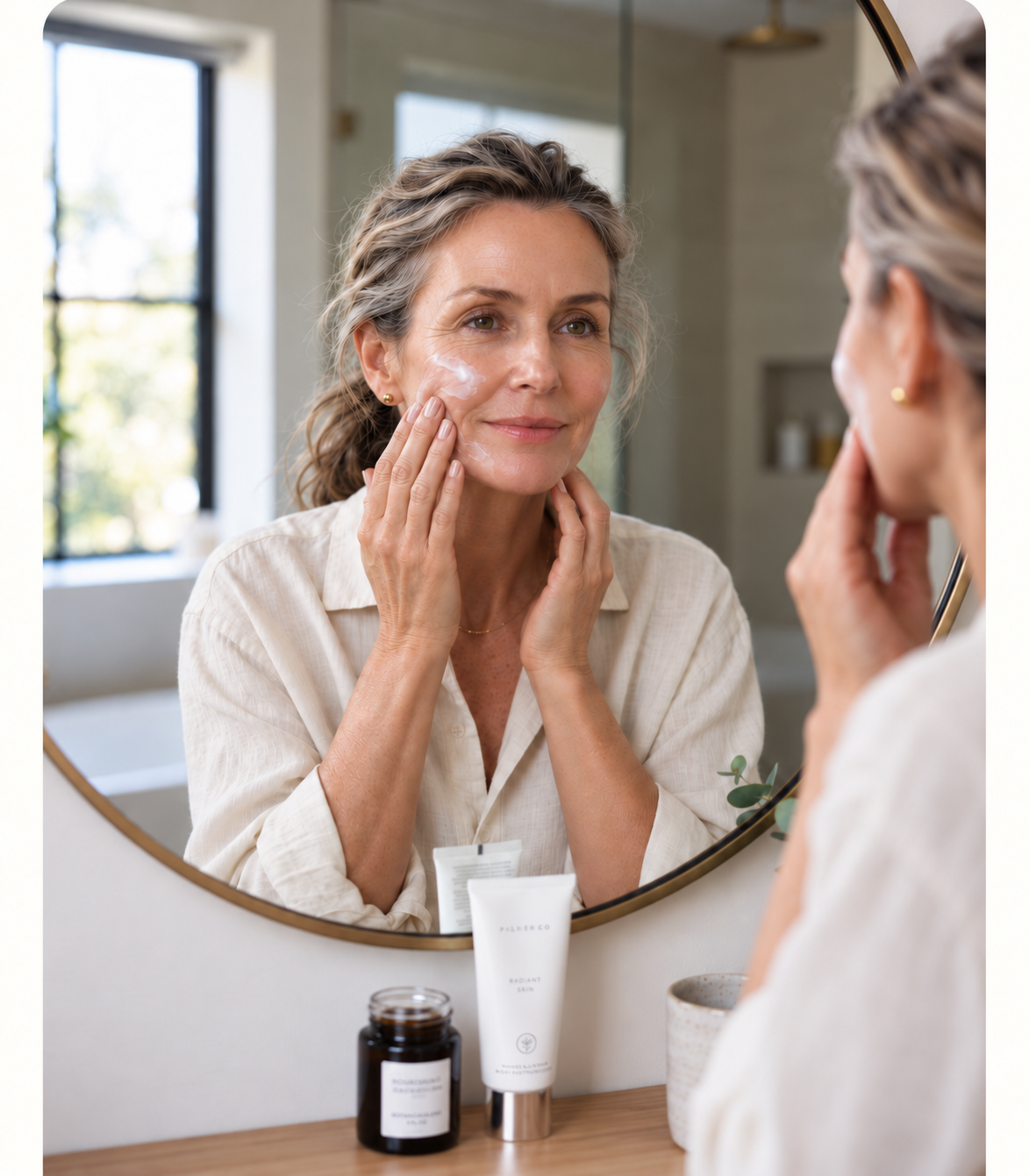
When skin becomes drier or more reactive, products that previously felt comfortable may become harder to tolerate.
Skin may become more sensitive and easily irritated around menopause, and pre-existing conditions such as eczema or rosacea can also change.
That doesn’t mean retinoids, exfoliating acids, vitamin C, or other active ingredients are suddenly “bad.”
It may mean your tolerance has changed.
And this is where women sometimes get into trouble.
The skin starts looking different, so we think:
I need to do more.
More exfoliation.
Stronger retinol.
Another serum.
A peel.
Maybe a device.
Meanwhile, the skin is standing in the corner waving a tiny white flag.
If something you’ve used for years suddenly becomes uncomfortable, don’t automatically push through it because it “used to work.”
Your skin is allowed to change its mind.
Why Am I Dry and Breaking Out at the Same Time?
Because apparently midlife enjoys keeping us humble.
Yes, dryness and acne can absolutely show up at the same time — and if that’s what your skin is doing, we go deeper into that exact combination here.
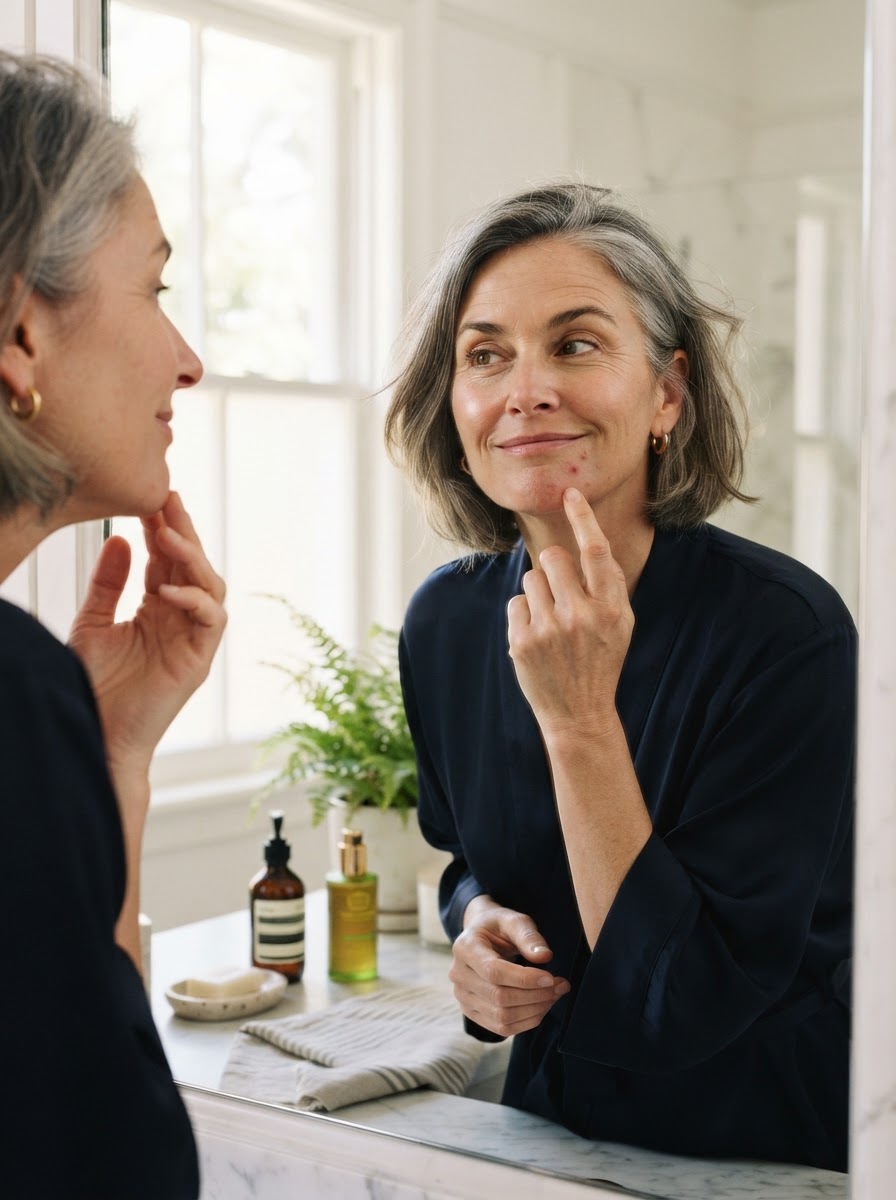
The American Academy of Dermatology notes that women can develop adult acne during perimenopause and menopause as hormone levels fluctuate.
Adult-onset acne can even appear in women who didn’t deal with much acne earlier in life.
And once again, I can personally confirm that this is not just something I’ve read about.
I’m in my late 50s.
I still get breakouts.
That’s the fact of my life.
Do I occasionally look at one and think:
“Really? We’re still doing this?”
Absolutely.
I thought acne and I had completed our relationship years ago.
Apparently it renewed the lease.
The important thing is that adult breakouts don’t automatically mean your entire face needs to be treated like teenage acne.
That’s where women can accidentally make things worse.
If your skin is already drier or more sensitive and you suddenly start attacking every breakout with acids, scrubs, benzoyl peroxide, retinoids, spot treatments, and sheer determination, you may end up with acne and an irritated skin barrier.
Now everybody’s unhappy.
So instead of automatically reaching for the strongest thing you can find, look at the whole picture:
- Where are you breaking out?
- How often?
- What are you already using?
- Is your skin also dry, tight, flaky, or sensitive?
- Are you layering several acne or exfoliating products?
- Could one of your products be contributing to clogged pores?
- Is the breakout occasional, or is it persistent and significant enough that a dermatologist should evaluate it?
Sometimes skincare is enough.
Sometimes it isn’t.
Knowing the difference matters.
Why Did My Old Skincare Routine Stop Working?
Because the routine was built for the skin you had then.
And you’re taking care of the skin you have now.
That doesn’t mean the entire routine has to go.
This is where I wish more skincare conversations started.
Before adding anything new, I like to look at a routine in three categories:
KEEP. PAUSE. REPLACE.
Not:
THROW EVERYTHING AWAY AND START OVER.
That category does not exist.
KEEP
What is still working?
If your cleanser feels good, keep it.
If your moisturizer still leaves your skin comfortable, keep it.
If you’ve used something for years and your skin still loves it, there is absolutely no reason to break up a perfectly good relationship because a new serum showed up on Instagram looking attractive.
PAUSE
What might be making things harder?
Maybe you’re exfoliating more often than your skin tolerates now.
Or maybe the opposite is happening.
Your skin may have a buildup of dead surface cells that is leaving it feeling rough, dull, congested, or like the products you’re applying are just sitting there instead of doing much of anything.
In that case, thoughtful exfoliation may actually be useful.
This is exactly why skincare gets tricky.
Too much exfoliation can irritate the skin.
Too little exfoliation may leave some women dealing with buildup, rough texture, or congestion.
So the question isn’t:
“Should women in midlife exfoliate?”
The better question is:
“Does your skin need exfoliation right now — and if so, what kind and how often?”
That’s where blindly following someone else’s routine can get you into trouble.
Your friend may love exfoliating three nights a week.
Your skin may respond with a strongly worded letter after one.
Or your skin may actually benefit from a little more exfoliation than it’s currently getting.
The goal is not to eliminate exfoliation or pile it on.
It’s to figure out what your skin is telling you.
And yes, sometimes your skin communicates like a moody teenager.
REPLACE
Only after we’ve looked at what’s working and what may be interfering do we ask:
What genuinely needs to change?
Maybe your cleanser is too stripping.
Maybe your moisturizer no longer gives you enough support.
Maybe you’re missing a product that addresses a real need.
Or maybe you have seven products and the answer is buying exactly zero more.
That happens too.
The point is to replace something because your skin needs something different — not because marketing convinced you your current moisturizer turned 50 and needs to retire with you.
The Now & Well
Keep / Pause / Replace Method
KEEP
What still works and feels good.
PAUSE
What may need a temporary timeout while you figure things out.
REPLACE
What genuinely no longer fits your skin’s needs.
Before You Buy Another Product, Look at These First
This is the bathroom-cabinet audit I want you to do.
Your cleanser
Does your skin feel comfortable afterward?
Or does it feel tight enough that you’re immediately reaching for moisturizer?
Your exfoliants
How many are you actually using?
An acid cleanser + exfoliating toner + serum + treatment mask can turn into a lot more exfoliation than it looks like on paper.
Your retinoid
Are you tolerating it?
Has your frequency stayed the same even though your skin has changed?
Your acne treatments
Are you treating an occasional chin breakout by drying your entire face?
Your serums
Do you know what each one is supposed to do?
If not, we’re already learning something.
Your moisturizer
Does it leave your skin comfortable for more than fifteen minutes?
Your sunscreen
Are you actually wearing it consistently?
Sun protection remains one of the most important ways to limit additional UV-related skin damage as we age.
And finally: how many “actives” are you using?
Sometimes women aren’t missing a product.
They’re missing restraint.
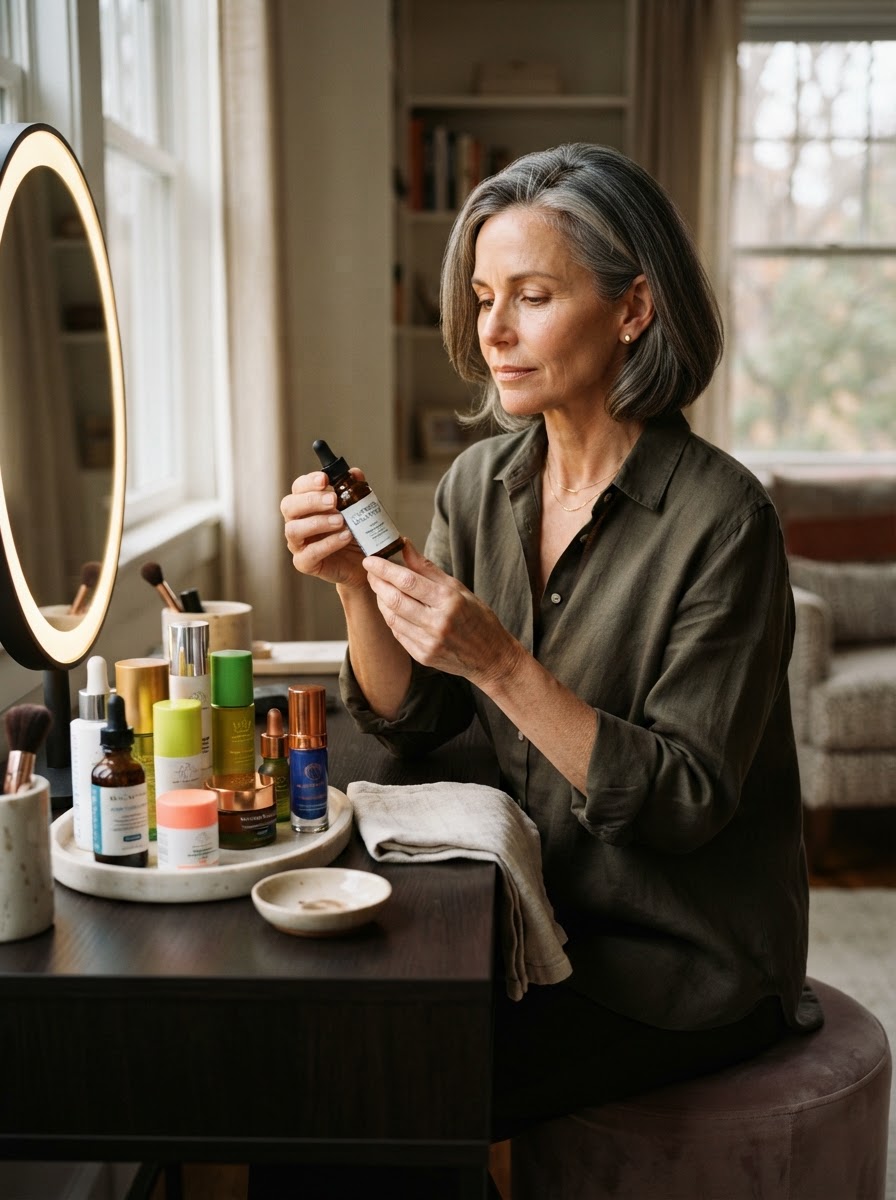
What Usually Helps When Your Skin Feels Completely Different?
There isn’t one universal menopause routine.
And I’m suspicious of anyone who claims there is.
But some fundamentals repeatedly make sense:
Cleanse gently.
Skin that is already dry or irritated usually doesn’t need to be scrubbed into submission.
Moisturize consistently.
Especially when dryness has become a major issue.
Use broad-spectrum sunscreen.
Sun exposure continues to contribute to visible skin aging and pigmentation changes.
Simplify when your skin is irritated.
More treatment is not always better treatment.
Introduce changes gradually.
If you start four things at once and something goes wrong, good luck figuring out which one did it.
Pay attention to what your skin is actually doing.
Not what somebody else’s skin is doing on Instagram.
And when something isn’t improving or doesn’t look like a normal cosmetic concern, get it checked.
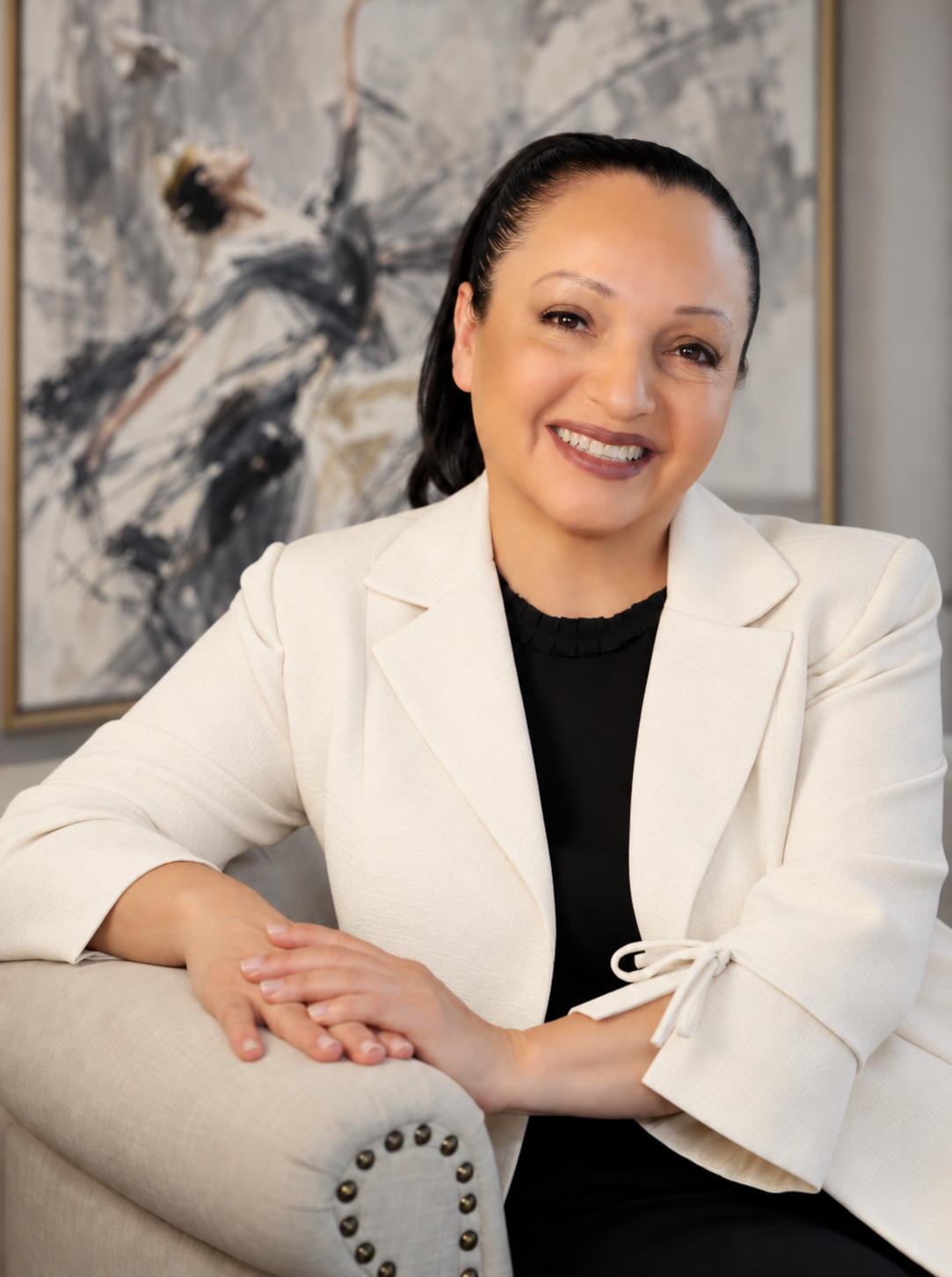
What I’ve Learned After 25+ Years Working With Skin — and Now Living This Myself
I’ve been an esthetician since 1999.
So you might think I was completely prepared when my own skin and body started changing.
I was not.
Apparently professional credentials do not prevent you from looking in the mirror and thinking:
“Excuse me, we had an agreement.”
I’m living this stage too.
The dryness.
Skin behaving differently.
Hot flashes.
Body changes.
The strange experience of realizing that things that worked for you for years don’t necessarily work the same way now.
And that has actually reinforced something I’ve believed professionally for a long time:
We need to stop treating skincare like a shopping problem.
Sometimes a woman comes to me convinced she needs five new products.
What she actually needs is someone to look at what she’s already doing.
That’s what I want Now & Well to be about.
Not pretending aging isn’t happening.
Not telling women they shouldn’t care about how they look because aging is “natural.”
Both things can be true.
I’m aging.
And yes, I still want to look good.
I want to take care of my skin.
I want to exercise.
I want to take wellness more seriously.
I want to feel strong and attractive and like myself.
I just don’t believe I need to buy everything being marketed to me in order to do it.
When It’s Time to See a Dermatologist
One of the most important things I’ve learned in aesthetics is knowing where my scope ends.
Changing skin can be normal.
But don’t automatically blame every new concern on perimenopause, menopause, or aging.
Talk with a dermatologist or appropriate healthcare professional about issues such as:
- Persistent or severe rashes
- Painful or cystic acne
- Skin that bleeds without an obvious reason
- Sores that aren’t healing
- New or changing moles or lesions
- Significant or sudden pigment changes
- Severe or persistent itching
- Rapid hair loss
- Symptoms that continue despite simplifying your routine
- Anything that concerns you
The goal is never to scare you.
It’s to make sure skincare doesn’t become a substitute for appropriate medical care.
The Bottom Line
Your skin may change in your 40s.
It may change again in your 50s.
And yes, you may still be figuring out new dryness, sensitivity, breakouts, texture, pigmentation, or other concerns in your 60s.
There isn’t one age when you’re supposed to have all of this figured out.
And there isn’t one magical “menopause skincare routine” every woman needs.
Start by understanding what changed.
Look at what you’re already using.
Keep what works.
Pause what may be making things harder.
Replace only what genuinely needs replacing.
And then build from there.
Because the answer isn’t automatically more.
You don’t need everything. You need what works for you now.