Wellness
Protein After 40: How Much Do Women in Perimenopause and Menopause Really Need?
By Margarita Santiago, LE, MA
Licensed Esthetician Since 1999 · Founder of Now & Well
Protein has become one of those things women in midlife are suddenly hearing about everywhere.
Eat more protein.
Have protein at every meal.
Drink a shake.
Track your grams.
Buy the powder.
Add protein to your coffee.
And if you are not careful, something that should be fairly simple can start to feel like another full-time job.
So let’s make this easier.
Protein matters.
It matters for muscle.
It matters for strength.
It matters for recovery.
And as we get older, paying attention to protein becomes more important.
But that does not mean every woman over 40 needs to start chasing 120 grams a day.
And it definitely does not mean you need a giant tub of protein powder sitting on your kitchen counter.
The better question is:
Am I getting enough protein for my body, my activity level, and the way I want to age?
That is a much more useful place to start.
First: Why Does Protein Matter More After 40?
As we get older, it becomes easier to lose muscle.
That matters because muscle is not just about how your arms look in a sleeveless shirt.
Muscle helps support:
- strength
- balance
- mobility
- independence
- metabolism
- bone health
- everyday movement
And during and after menopause, women may notice changes in body composition, muscle mass, strength and recovery.
At the same time, our muscles can become less responsive to the protein we eat.
In simple terms:
Your body may need a stronger signal than it did when you were younger.
That is one reason protein and strength training get so much attention in healthy aging research.
Is the Standard Protein Recommendation Enough?
The standard adult protein recommendation is about:
0.8 grams of protein per kilogram of body weight per day.
But that number is mainly designed to cover basic protein needs in most healthy adults.
It does not necessarily answer this question:
What amount may help me hold onto muscle as I get older?
Research in older adults often points toward a higher range, around:
1.0 to 1.2 grams per kilogram per day
for healthy older adults, with higher amounts sometimes suggested during illness, recovery, or when someone is at risk of losing muscle.
That does not mean every healthy 42-year-old woman needs to follow recommendations written for someone in her 70s.
And I do not want us turning protein into another number women feel they are failing to hit.
The better takeaway is:
0.8 g/kg is a starting point. Some women may benefit from more, especially as they get older or become more active.
What Does the Research Say in Postmenopausal Women?
A 2026 review looked at 34 studies involving more than 1,500 postmenopausal women.
One of the clearest findings was this:
Strength training consistently helped improve strength and body composition.
Adding more protein did not always produce an extra benefit when women were already eating enough protein.
That does not mean protein is unimportant.
It means:
Eating enough protein matters. Eating unlimited protein is not the goal.
This is important because the internet can make it sound like:
“If 90 grams is good, then 140 must be better.”
That is not how it works.
More is not automatically better.
Most of the stronger research we have is in postmenopausal women and older adults, so we should be careful about assuming the exact same numbers apply to every woman in her 40s or every woman in early perimenopause.
Strength Training Is Still the Bigger Piece
This may be the most important part of this entire article.
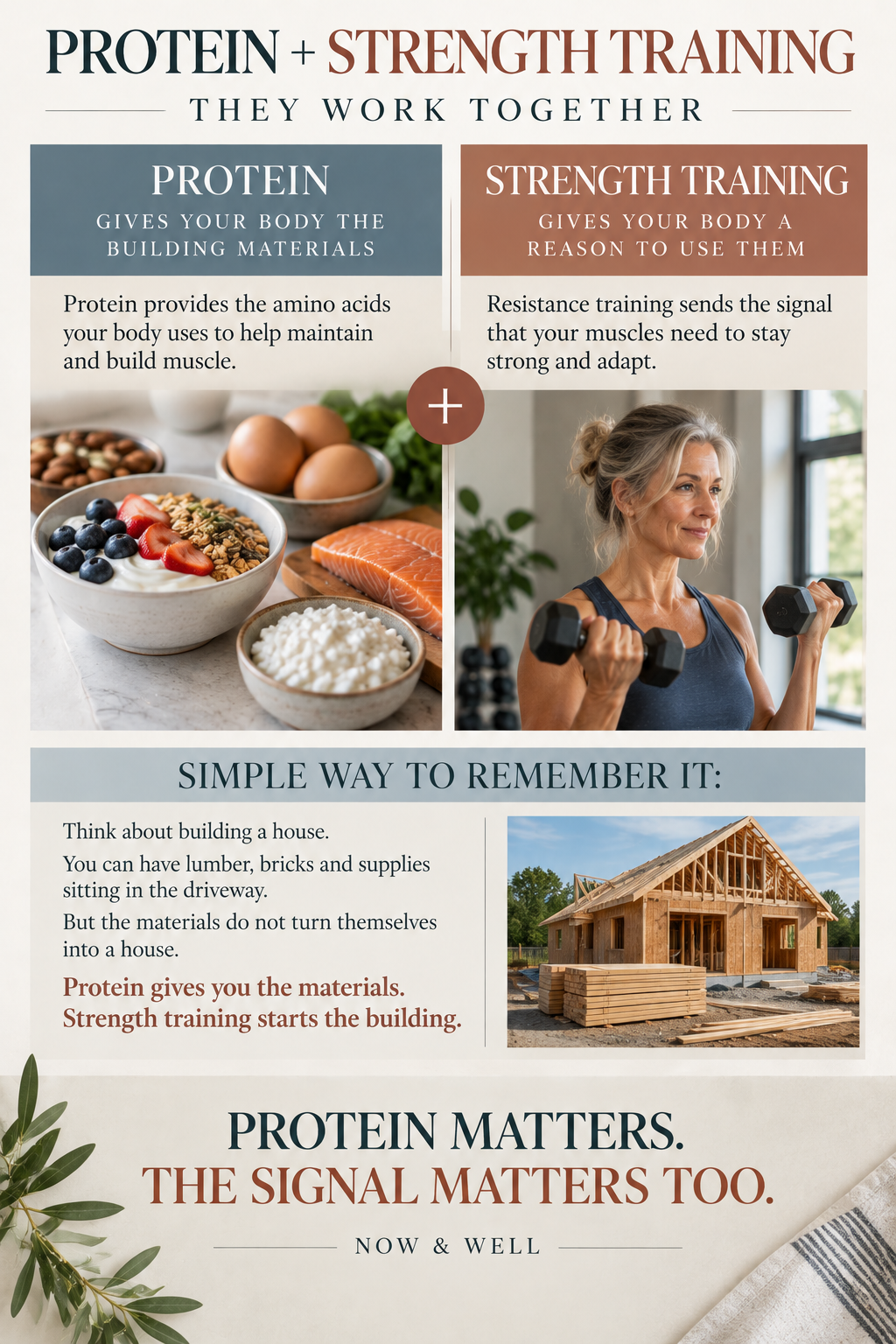
Protein gives your body the material it needs to build and maintain muscle.
But your body still needs a reason to use that material.
Think about building a house.
You can have:
- lumber
- bricks
- nails
- tools
- supplies
all sitting in the driveway.
But if nobody starts building, those materials do not turn themselves into a house.
Protein works the same way.
Protein gives you the building materials. Strength training gives your body a reason to use them.
That is why I would never tell a woman:
“Just drink more protein shakes.”
If you want to maintain or build muscle, strength training matters.
Does More Protein Automatically Mean More Muscle?
No.
There is a point where adding more and more protein does not automatically mean more muscle.
If your protein intake is already adequate, the next big question is:
Are you actually giving your muscles a reason to stay strong?
That means looking at:
- resistance training
- enough total food
- enough protein
- sleep
- recovery
- consistency
A protein shake cannot replace those things.
How Much Protein Should You Have at One Meal?
For many women, this is easier to think about than one giant daily number.
Research in older adults often uses around:
25 to 30 grams of protein per meal
as a practical reference point for supporting muscle.
It is not a perfect number every woman has to hit.
It means you can start asking:
Does breakfast have real protein?
Does lunch have real protein?
Does dinner have real protein?
That is much more practical than walking around with a calculator all day.
Breakfast Is Where Many Women Fall Short
This is one of the easiest places to improve.
A common breakfast might be:
- coffee
- toast
- fruit
- oatmeal
- cereal
- a muffin
And then most of the protein shows up at dinner.
You do not have to completely change your breakfast.
You can simply make it stronger.
Instead of:
toast + coffee
try:
eggs + toast + fruit
Instead of:
plain oatmeal
try:
oatmeal + Greek yogurt + nuts
Or:
Greek yogurt + berries + seeds
Or:
cottage cheese + fruit
Or:
a smoothie with milk or protein powder
The point is not perfection.
The point is:
spread your protein through the day instead of saving nearly all of it for dinner.
What Are Good Protein Foods?
You do not need supplements to get protein.
There are plenty of good options.
Animal-Based Protein
- eggs
- Greek yogurt
- cottage cheese
- chicken
- turkey
- fish
- lean beef
- milk
Plant-Based Protein
- beans
- lentils
- tofu
- tempeh
- edamame
- soy milk
- nuts
- seeds
You do not need to choose a side.
The better question is:
Are you getting enough protein from foods you enjoy and will actually keep eating?
That matters more than joining a protein camp.
Plant Protein vs. Animal Protein
Animal proteins often provide more protein in a smaller serving and naturally contain all of the essential amino acids your body needs.
Plant proteins can absolutely contribute too.
If you prefer plant-based eating, you can still meet your protein needs.
You may simply need to:
- eat a little more total food
- use a wider variety of protein sources
- pay attention to the amount of protein in each serving
The goal is not to make plant protein seem inferior.
It is to understand that the total amount and variety may matter.
Do Women Need Protein Powder?
Not necessarily.
Protein powder is useful because it is convenient.
That is really the main reason I like it.
If you are busy, not very hungry, or struggling to get enough protein from food, a shake can make things easier.
But a protein powder is not automatically healthier than:
- eggs
- yogurt
- cottage cheese
- fish
- chicken
- beans
- tofu
- lentils
A supplement should solve a problem.
It should not create another problem to shop for.
If You Want a Protein Powder, Here Are 3 I Would Look At
If protein powder would make it easier for you to get enough protein consistently, you do not need to stand in the supplement aisle comparing 25 different tubs.
I would start with a few simple questions:
- What type of protein is it?
- How much protein am I getting per serving?
- Does it contain a long list of things I do not need?
- Has it been independently tested?
- Will I actually use it?
Here are three options I would look at.
Klean Athlete KLEAN Isolate
Best for: A simple whey protein option
Klean Athlete KLEAN Isolate is a whey protein isolate with about 20 grams of protein per serving.
I like that it keeps things fairly simple, and it is NSF Certified for Sport, which means the product goes through independent quality testing instead of asking us to rely only on what the company says about itself.
Whey protein is also important here because it is one of the protein types that has actually been studied in postmenopausal women.
That does not mean this exact product has been proven to prevent muscle loss during menopause.
It means the type of protein—whey—has research behind it, and this particular product gives us the added benefit of independent quality testing.
Margarita’s take:
If you use dairy and want a straightforward whey protein without turning your shake into a science experiment, this is one I would consider.
Momentous Whey Protein Isolate
Best for: A premium whey option
Momentous Whey Protein Isolate is another whey-based option with about 20 grams of protein per serving.
It is also NSF Certified for Sport.
Again, the reason I am including it is not because the word “premium” magically makes protein work better.
The reason is simpler:
- whey has research behind it
- the protein amount is meaningful
- the product has independent quality verification
That gives me more confidence than a powder with beautiful packaging and a long list of claims but very little information behind it.
Margarita’s take:
This is the type of product I would look at if you want a higher-end whey protein and independent testing matters to you.
Garden of Life Organic Plant-Based Performance Protein
Best for: A higher-protein dairy-free option
Not every woman wants or tolerates whey protein.
Garden of Life Organic Plant-Based Performance Protein provides about 30 grams of plant protein per serving and is NSF Certified for Sport.
I want to be clear about why I am including it.
The strongest supplement research we currently have specifically in postmenopausal women is more directly connected to whey protein, not this exact plant-based product.
I am including this as a practical dairy-free option, not because this exact product has been proven to work better for women in menopause.
I am including it because women who avoid dairy still deserve an option that gives them a meaningful amount of protein in one serving.
Plant protein can absolutely help you meet your daily protein needs.
You may simply need to pay a little more attention to the amount you are getting and the overall quality and variety of protein in your diet.
Margarita’s take:
If you prefer plant-based protein, do not tolerate dairy, or simply want a dairy-free choice, this is one I would consider.
Why These Three?
I did not choose them because they have the prettiest packaging.
And I am not saying these are the only good protein powders available.
I chose them because they meet two things I want us to look for at NOW & WELL.
1. The type of protein should make sense for the goal.
Whey protein has research behind it for supporting muscle when combined with resistance training.
Plant protein can also help women meet their daily protein needs, especially when dairy is not a good option.
2. I want some outside quality verification when possible.
All three of these products have independent NSF Certified for Sport testing.
That gives us another layer of information beyond the brand simply saying:
“Trust us. Our product is great.”
And remember:
A protein powder should make getting enough protein easier. It should not convince you that you suddenly need a very expensive daily shake.
Whey Protein: What Does the Evidence Say?
Whey protein has been studied in postmenopausal women.
A review looking at whey protein in this group included 14 studies.
The results again showed something we keep seeing:
resistance training matters.
Whey may be useful because it is:
- convenient
- easy to measure
- high in protein
- rich in the amino acids muscles use
But simply drinking whey protein does not guarantee you will build muscle.
I would think of whey as:
a convenient way to help meet your protein needs
not:
magic muscle powder
What About Protein and Weight Loss?
Protein may help with:
- fullness
- keeping meals satisfying
- maintaining muscle during weight loss
But protein does not automatically cause weight loss.
A large protein smoothie can still contain a lot of calories.
So if your goal is weight loss, do not think:
“I should add protein on top of everything else I already eat.”
Sometimes it makes more sense to replace a lower-protein meal or snack with something more satisfying.
What About Bone Health?
Protein is part of healthy bones and muscles.
But I would not tell women:
“Eat more protein and prevent osteoporosis.”
Bone health is bigger than one nutrient.
It can include:
- resistance training
- weight-bearing activity
- calcium
- vitamin D
- enough overall nutrition
- hormone changes
- medical treatment when needed
Protein is part of the picture.
It is not the whole picture.
What About Kidney Health?
For healthy people, eating more protein within reasonable amounts is not the same thing as damaging your kidneys.
But kidney disease changes the conversation.
If you have:
- kidney disease
- abnormal kidney test results
- reduced kidney function
- another medical condition that changes your protein needs
ask your healthcare provider or dietitian what amount is right for you.
Do not assume a high-protein diet is right for everyone.
Do I Need to Count Every Gram?
No.
You can track protein if numbers help you.
But you do not need to turn every meal into a math problem.
A much easier starting point is:
Look at your plate. Where is the protein?
Breakfast?
Lunch?
Dinner?
Snack?
If you cannot really answer that, then you have something useful to work on.
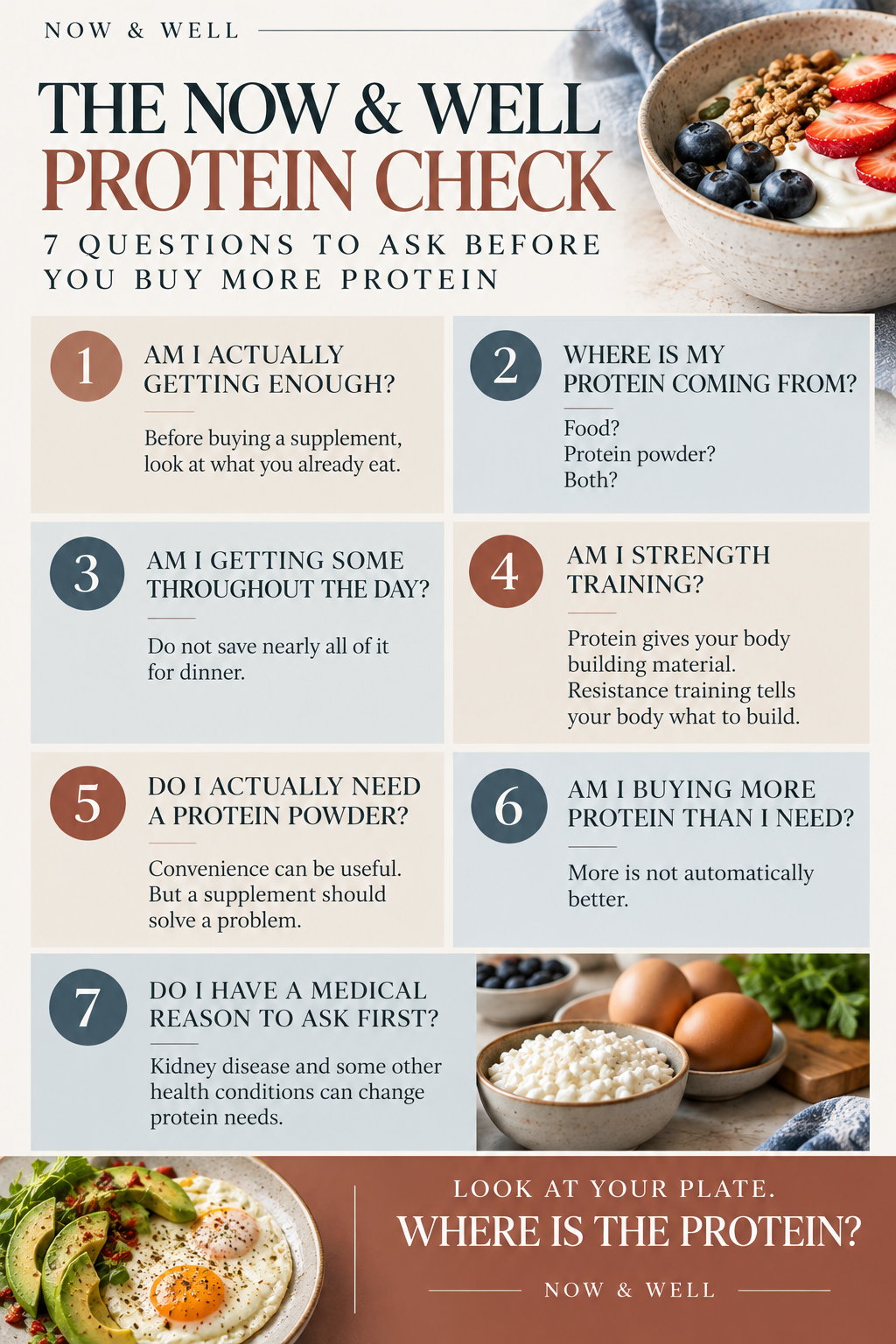
THE NOW & WELL PROTEIN CHECK
Before buying another protein product, ask:
1. AM I ACTUALLY GETTING ENOUGH?
Before buying a supplement, look at what you already eat.
2. WHERE IS MY PROTEIN COMING FROM?
Food?
Protein powder?
Both?
3. AM I GETTING SOME THROUGHOUT THE DAY?
Do not save nearly all of it for dinner.
4. AM I STRENGTH TRAINING?
Protein gives your body building material.
Resistance training tells your body what to build.
5. DO I ACTUALLY NEED A PROTEIN POWDER?
Convenience can be useful.
But a supplement should solve a problem.
6. AM I BUYING MORE PROTEIN THAN I NEED?
More is not automatically better.
7. DO I HAVE A MEDICAL REASON TO ASK FIRST?
Kidney disease and some other health conditions can change protein needs.
So, Do Women Over 40 Need More Protein?
For the right woman?
Yes. Pay attention to protein.
Especially if:
- you are in midlife or beyond
- you strength train
- you want to maintain muscle
- you are losing weight
- your meals are often low in protein
Maybe. Consider a protein powder.
If:
- food alone is not convenient
- you skip meals
- breakfast is consistently low in protein
- appetite makes it hard to eat enough
- you want an easy post-workout option
No. You probably do not need another expensive supplement.
If:
- you already get enough protein from food
- you are buying it because social media scared you
- you think powder will build muscle without strength training
- the product is expensive mainly because it says “women over 40”
Keep your money.
The Bottom Line
Protein matters.
Especially as we get older.
But I do not want you thinking you failed because you did not hit a perfect number today.
The goal is much simpler:
eat enough protein, spread it through the day, and give your muscles a reason to use it.
That is why I keep coming back to this:
Protein gives your body the building materials. Strength training gives it a reason to use them.
And if a protein powder helps make that easier?
Great.
Use it.
If you can do it with food?
Also great.
You do not need the most expensive option.
You need the option that fits your life and helps you stay consistent.
And if you are also weighing creatine for women in perimenopause and menopause, that article walks through a similar filter for another supplement that is getting a lot of attention after 40.
For a wider look at natural help for perimenopause and menopause, including how supplements fit into the bigger picture, that guide is a good next stop.
You don’t need everything. You need what works for you now.
— Margarita
Frequently Asked Questions
Sources & Further Reading
- Nutrition strategies combined with resistance training in postmenopausal women. 2026. Systematic review of 34 studies involving 1,541 postmenopausal women.
- Resistance training in postmenopausal women. 2024. Supports discussion of improvements in upper- and lower-body strength with resistance training.
- Whey protein supplementation in postmenopausal women. Systematic review including 14 studies.
- Protein recommendations for healthy aging / PROT-AGE Study Group. Supports discussion of approximately 1.0–1.2 g/kg/day protein intake recommendations in healthy older adults.
- Protein distribution and per-meal intake in older adults. Supports discussion of meaningful protein intake across meals and approximately 25–30 g per meal as a practical reference point.
- Whey protein supplementation, strength, body composition, and physical performance in older adults.
This article is for general educational purposes and does not provide medical diagnosis or treatment. Consult an appropriate licensed healthcare professional or registered dietitian for medical concerns and before making significant changes to your diet or supplement routine.
Still deciding what belongs in your routine?
If you’d rather have someone review what you’re using, what changed, and what may actually make sense for your skin now, The Midlife Skin Reset consultation is designed for exactly that.