Beauty Tech

LED & Red Light Therapy After 40: Skin, Hair, Pain—and What the Evidence Really Shows

By Margarita Santiago, LE, MA

Licensed Esthetician Since 1999 · Founder of Now & Well

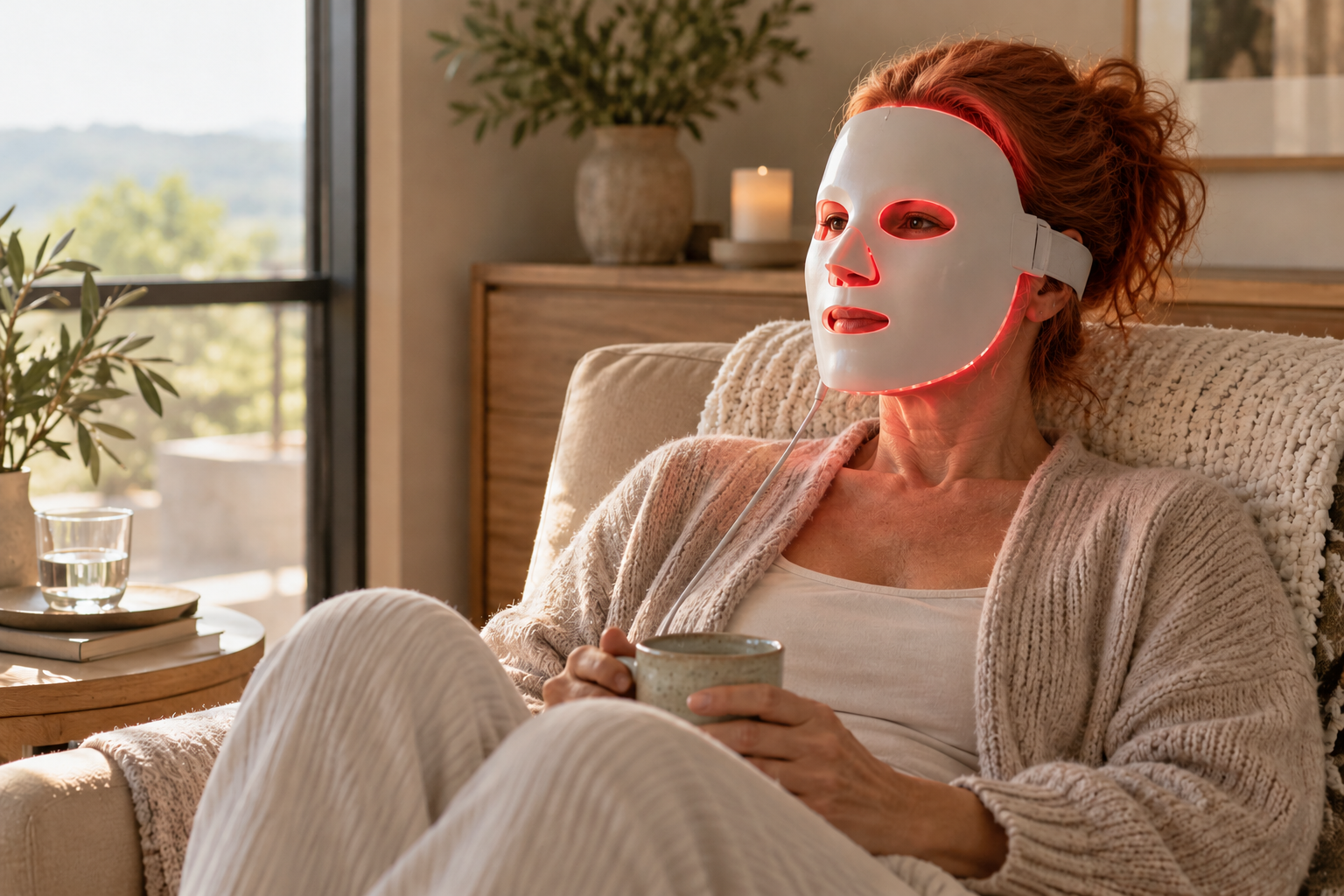
Midlife woman using an LED red light therapy mask at home

There was a time when red light therapy was something you were more likely to see in a dermatologist’s office, physical therapy clinic, or tucked into the corner of a treatment room.

Now?

It is everywhere.

Face masks. Wands. Panels. Helmets. Caps. Belts. Wraps.

Some promise smoother skin and fewer wrinkles. Others claim to help acne, regrow hair, reduce inflammation, ease sore joints, speed recovery, improve circulation, and do just about everything short of folding the laundry.

Whenever one technology starts collecting this many promises, I get curious.

Not because I automatically think it is nonsense.

And not because I automatically believe the marketing.

I want to know:

What does the technology actually do?

Which claims have decent evidence behind them?

Which ones are promising but still early?

And perhaps most important if you are about to spend a few hundred dollars:

Is the device you are buying actually designed for the result you want?

That last question matters more than most people realize.

Because a red-light face mask, a scalp helmet and a near-infrared panel may all fall under the broad photobiomodulation umbrella, but that does not mean they are interchangeable.

So no, red light therapy is not simply another beauty gimmick.

But it is also not one magical red glow that does everything.

Let’s sort it out.

First: What Is Red Light Therapy?

Red light therapy uses specific wavelengths of visible red light—and sometimes invisible near-infrared light—to expose tissues to light without the heat or tissue destruction associated with many traditional lasers.

The broader scientific term you will often see is photobiomodulation, or PBM.

The basic idea is that certain wavelengths of light can interact with cells and influence biological processes. Exactly what happens depends on factors including the wavelength, energy delivered, treatment time, tissue being targeted and the device itself.

That is why I don’t love statements such as:

“Red light increases collagen.”

That can be directionally reasonable in the right context, but it leaves out an awful lot.

Which wavelength? At what dose? How often? Delivered by what device? Studied on whom?

Those details matter.

The American Academy of Dermatology describes red-light therapy as a noninvasive treatment using red or near-infrared light and notes that dermatologists may use it as part of treatment plans for signs of aging, acne, hair loss and other concerns. At-home devices are generally less powerful than the equipment used professionally.

LED, Red Light, Near-Infrared, Laser: Are They the Same Thing?

Not exactly.

LED

LED simply means light-emitting diode.

It describes the light source.

An LED can emit different wavelengths depending on how the device is designed.

Red light

Red light is visible.

Many aesthetic devices use wavelengths somewhere in the red portion of the spectrum. You will often see numbers in the 600-nanometer range advertised on skincare devices.

Near-infrared light

Near-infrared, usually abbreviated NIR, is invisible to the eye and has different penetration characteristics from visible red light.

It is frequently combined with red light in photobiomodulation devices.

Low-level laser therapy

Some PBM research uses low-power lasers rather than LEDs.

That becomes very important when we start talking about pain studies.

A study using a particular laser at a carefully measured dose on a knee joint does not automatically prove that your facial LED mask can be strapped to your knee and produce the same result.

Same general family.

Not necessarily the same treatment.

Does Red Light Therapy Actually Work for Midlife Skin?

This is one of the more encouraging areas of research.

And we now have a study that is especially relevant to women in midlife.

A 2025 randomized, sham-controlled, double-blind clinical trial included 95 women between ages 45 and 60. Participants used a red LED mask delivering 660 ± 10 nm light either two or three times a week for four weeks.

Researchers found significant reductions in some measured wrinkle dimensions compared with the sham group, although not every wrinkle-assessment measure showed a significant difference. Participant satisfaction was also higher in the treatment groups. Interestingly, using the mask three times weekly did not clearly outperform twice-weekly use in the outcomes measured.

I like this study because it gives us a more realistic answer than:

“Red light erases wrinkles.”

It doesn’t.

What it suggests is that consistent red-light use may modestly improve certain signs of facial aging.

That is a very different promise.

A 2026 review examining home dermatologic devices also rated LED therapy as having moderate-quality evidence for facial rejuvenation, while noting that evidence varies considerably across different types of at-home devices.

The American Academy of Dermatology similarly reports that research suggests red-light devices may improve signs of aging such as fine lines, roughness, discoloration, redness and skin laxity, but emphasizes that devices and protocols differ.

My translation?

LED deserves a place in the conversation.

But I would think of it as:

gradual skin support, not an at-home facelift.

If someone is selling you the second one, I would keep my credit card in my purse.

What Can Red Light Realistically Do for Aging Skin?

Depending on the device and protocol, the research is most interesting for things such as:

  • fine lines
  • wrinkle appearance
  • overall skin quality
  • texture
  • some redness
  • signs of photodamage
  • modest improvements in firmness or the appearance of laxity

The word modest matters.

There is a tremendous difference between improving the appearance of aging skin and physically repositioning sagging tissue.

An LED mask is not replacing surgery.

It isn’t replacing every professional treatment either.

And it does not need to.

A treatment can be worthwhile without being dramatic.

Sometimes the right question is simply:

If I use this consistently, can it make my skin look a little better over time?

For a good-quality LED device used correctly, the answer may be yes.

What About Acne?

This one requires a little more explanation because red and blue light do different jobs.

Blue-light therapy has been studied for acne partly because of its effects on acne-associated bacteria.

Red light is more often discussed for its effects on inflammation and tissue response.

And some acne devices combine both.

A 2026 review found moderate-quality evidence for blue LED and combined blue-red LED home devices for acne, whereas red LED alone had lower-quality evidence.

The American Academy of Dermatology also makes an important distinction: visible red, blue and combined red-blue light may help treat pimples, but they do not reliably treat every type of acne lesion.

Visible light is not considered effective for:

  • blackheads
  • whiteheads
  • acne cysts
  • acne nodules

And light treatment alone rarely clears acne completely.

That matters for women in midlife because not every breakout is the same. If you are dealing with a few inflamed pimples, an appropriate LED device may be a useful addition. If you are dealing with deeper hormonal cysts along the jawline, do not let an LED-mask ad convince you that you have found the entire answer.

For more on why midlife skin can be dry and breaking out at the same time, read Why Am I Dry and Breaking Out at the Same Time?.

Different problem. Different strategy.

Can Red Light Help Hair Loss?

This is another area where the answer is more encouraging than many people realize.

Red and low-level light therapies have been studied for androgenetic alopecia, the medical name for hereditary pattern hair loss.

For women, this is commonly called female-pattern hair loss.

The American Academy of Dermatology notes that randomized controlled trials have shown some hair regrowth, including improvements in hair thickness and length, in people with hereditary hair loss. Several at-home light devices—such as caps, combs and helmets—have received FDA clearance for hair-growth indications.

But here comes an important Now & Well rule:

A Face Mask Is Not a Hair-Growth Helmet

I know that sounds obvious.

But once we start seeing “red light = hair growth,” it becomes very easy to assume that all red-light devices are essentially doing the same thing.

They aren’t.

A device designed for the scalp has:

  • different positioning
  • different coverage
  • different treatment geometry
  • potentially different wavelengths
  • potentially different dose parameters
  • a different intended use

If hair loss is the goal, evaluate a device specifically designed and studied for the scalp.

And before buying one, it is worth knowing why your hair is thinning.

Hair loss can have many causes.

A light device that may help hereditary female-pattern hair loss will not necessarily address hair shedding caused by iron deficiency, thyroid disease, medication, illness or another underlying cause.
LED Isn’t Just for Beauty: What About Pain?

This is where red-light therapy becomes especially interesting.

Photobiomodulation has been studied well beyond skincare.

Researchers have explored it for:

  • osteoarthritis
  • neck pain
  • shoulder pain
  • muscle recovery
  • tendon-related problems
  • wound healing
  • inflammatory conditions
  • rehabilitation applications

But we need to be careful here.

The fact that PBM is used in research for pain does not mean every consumer red-light product is an evidence-based pain treatment.

Knee osteoarthritis

A 2024 systematic review and meta-analysis included 10 randomized placebo-controlled studies with 542 participants who had knee osteoarthritis.

Photobiomodulation produced a statistically significant improvement in resting pain compared with placebo.

Sounds impressive.

But here is the part marketing often leaves out:

The researchers rated the certainty of the evidence very low because of issues including risk of bias and differences among studies. They concluded that the evidence was not strong enough to recommend PBM as a stand-alone treatment, although it may have a role alongside better-established therapies.

That is exactly how I want us to think about evidence.

Not:

“It worked in studies, so it is proven.”

And not:

“The evidence isn’t perfect, so it is useless.”

Instead:

There is a signal worth paying attention to, but we need to understand how strong that signal actually is.

Neck and shoulder pain

A 2024 review examined 36 clinical studies involving photobiomodulation for shoulder and neck pain.

The authors reported promising findings for pain relief and functional improvement, with infrared wavelengths being commonly used. But once again, treatment protocols varied considerably, making it difficult to define one universal approach.

So yes:

PBM may have legitimate applications for pain.

But that does not mean:

Any red-light device treats pain.

A Beauty Mask Is Not Automatically a Pain-Therapy Device

This deserves its own section because it is one of the easiest ways to waste money.

Imagine two devices.

One is a soft facial mask designed to deliver red light across the surface of your face.

Another is a therapeutic device designed to deliver infrared light directly to tissues around a painful knee.

Both might be described as photobiomodulation.

That does not make them equivalent.

Pain studies may use very different:

  • wavelengths
  • power densities
  • total energy doses
  • treatment times
  • distances from the tissue
  • light sources
  • treatment areas
  • clinical protocols

Some use lasers.

Some use LEDs.

Some use contact probes.

Some use arrays or panels.

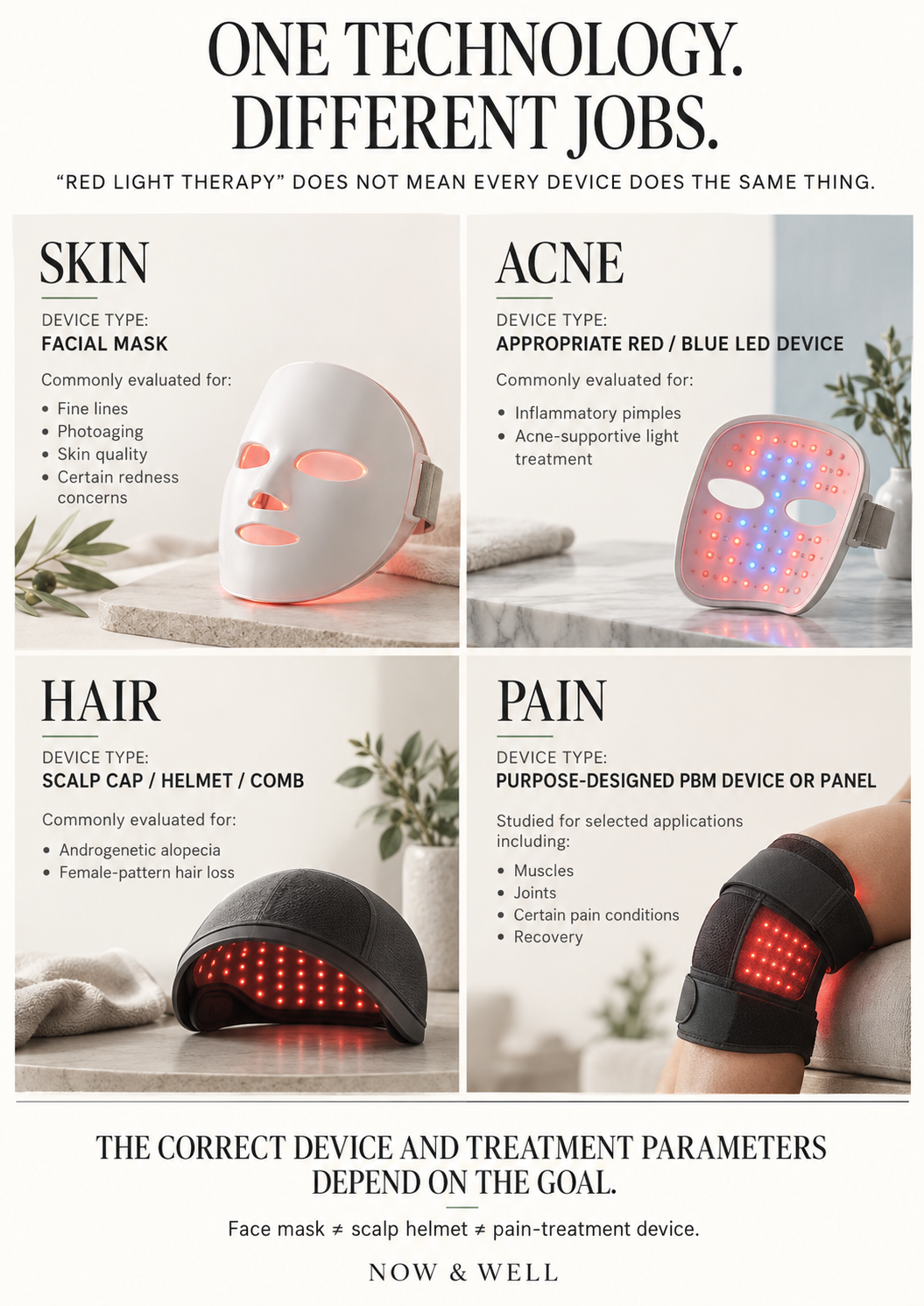
The lesson:

Do not buy the technology. Buy the correct application of the technology.

If your goal is wrinkles, evaluate a wrinkle device.

If your goal is scalp hair growth, evaluate a hair device.

If your goal is knee pain, evaluate the evidence for a device and protocol intended for pain.

Same red glow does not automatically mean same biological dose.

Different red light therapy devices for skin acne hair and pain

Red Light vs Near-Infrared: Which One Is Better?

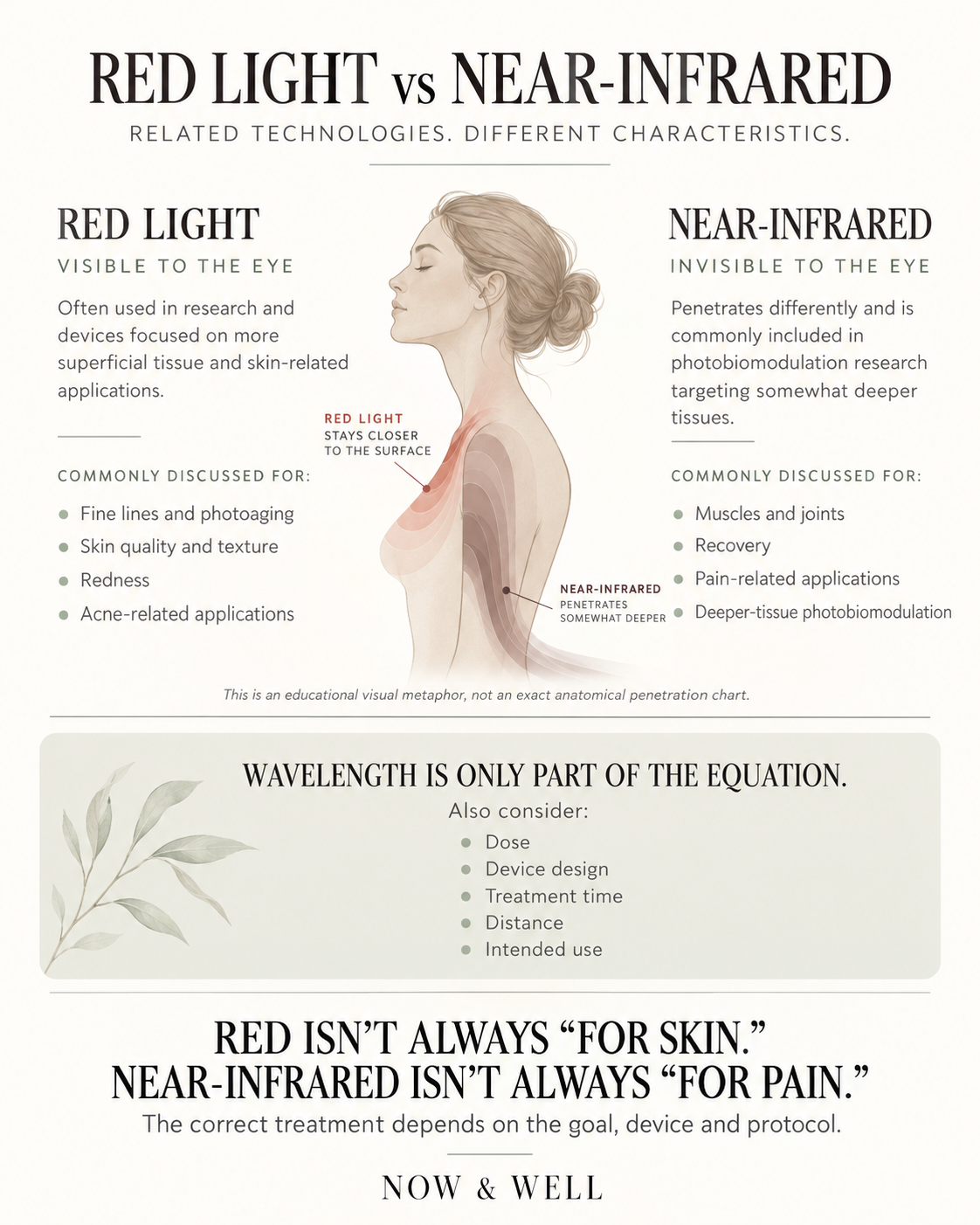
Neither is universally “better.”

They serve somewhat different purposes.

Red light

Visible red wavelengths are commonly used in skincare applications because they can interact with more superficial tissues.

This is why you see red LED frequently marketed for:

  • photoaging
  • fine lines
  • skin quality
  • redness
  • acne-related applications

Near-infrared

Near-infrared is invisible and penetrates differently.

You will frequently see NIR included in devices intended to reach somewhat deeper tissues and in research involving muscles, joints and recovery.

But please don’t reduce this to:

“Red = skin. Infrared = pain.”

Biology is rarely that tidy.

Both wavelength and dose matter.

Which brings us to one of the most overlooked parts of shopping for an LED device.

Red light versus near-infrared therapy comparison

The Spec Nobody Talks About Enough: Dose

Companies love to tell you how many LEDs they have.

“236 LEDs!”

“Triple-chip technology!”

“Seven wavelengths!”

Wonderful.

But the number of little lights on the mask is not the same as knowing how much useful light reaches the tissue.

Photobiomodulation depends on treatment parameters.

Depending on the research you are looking at, you may see terms such as:

  • wavelength
  • irradiance
  • power density
  • fluence
  • joules per square centimeter
  • treatment duration
  • distance from skin

Don’t worry—I am not turning Now & Well into physics class.

You do not need to become an optical engineer to buy a face mask.

But I do want you to know that wavelength alone is not enough.

Two products can both advertise “633 nm red light” and still deliver very different treatments.

This is one reason I become cautious when a manufacturer gives you a beautifully designed page full of “collagen,” “cellular energy” and glowing before-and-afters—but makes it nearly impossible to find meaningful technical information.

Transparency matters.

Does More Power Mean Better?

Not necessarily.

This is another place where beauty-tech marketing can become a little too much like comparing stereo speakers.

Higher number = better.

Except biology doesn’t always work that way.

Photobiomodulation responses can depend on receiving an appropriate therapeutic dose.

Too little may not produce the desired effect.

But simply blasting tissue with more light does not automatically mean you get more benefit.

This is why I would rather see a device with thoughtful treatment parameters and clinical support than one whose entire sales pitch is:

“OURS HAS MORE LEDS.”

At-Home LED vs Professional LED

Professional devices are generally more powerful and can be used as part of a more comprehensive treatment strategy.

Dermatologists may combine light treatment with other approaches depending on the concern.

The American Academy of Dermatology notes that professional red-light treatment is stronger than most consumer devices, while home devices may sometimes be recommended for maintenance or ongoing use.

But home devices have one major advantage:

Convenience.

A professional device that you use twice a year and an at-home device you actually use several times a week are different experiences.

Consistency matters.

Which is why one of my buying questions is always:

Will you actually use this?

A $500 LED mask stored beautifully in your bathroom drawer has an irradiance of approximately zero.

What Does “FDA Cleared” Actually Mean?

This language gets messy in beauty-tech advertising.

You may see:

  • FDA cleared
  • FDA approved
  • FDA registered
  • FDA certified

and all four can sound like:

“The government proved this works.”

That is not what they mean.

For many over-the-counter light-based devices, 510(k) clearance means the device went through the applicable FDA pathway and was found substantially equivalent to an appropriate legally marketed device for its intended use.

It is meaningful.

But it is not the same thing as FDA independently verifying every statement appearing in an Instagram ad.

The American Academy of Dermatology specifically cautions consumers not to interpret FDA clearance as proof of every performance claim made for a red-light device.

So when you see:

FDA-cleared

My response is:

Good.

Now I still want to know:

  • Cleared for what?
  • Which exact model?
  • What is its intended use?
  • What evidence supports the result I want?

A Device I Own: Solawave 4-in-1 Radiant Renewal Skincare Wand

I own the Solawave 4-in-1 Radiant Renewal Skincare Wand, so this is a good example of why it is important to understand what technology is actually inside a beauty device.

It is not simply “a red-light wand.”

The current device combines four technologies:

  • 630 nm red light
  • galvanic current
  • therapeutic warmth
  • facial massage/vibration

Solawave recommends 12-minute sessions, treating approximately three minutes per facial area, three to five times weekly. The current model uses 14 LEDs powered by seven dual-core chips.

The FDA database lists the Radiant Renewal Skincare Wand under a 510(k) clearance for an over-the-counter light-based wrinkle-reduction device, with a substantially-equivalent decision issued in April 2025.

What I particularly want you to notice is this:

If a multi-technology device improves your skin, it can be difficult to say which part deserves the credit.

Was it:

  • red light?
  • warmth?
  • massage?
  • galvanic current?
  • the serum?
  • using skincare more consistently because the device created a routine?
  • a combination?

That does not make the device bad.

It simply makes the claim more complicated.

Ownership is not proof of effectiveness, and a positive experience with a device does not automatically tell us which mechanism produced the improvement.

That distinction is important to me.

What About All the Other LED Masks?

There are now many recognizable names in this space.

You will see products from companies such as:

  • Omnilux
  • CurrentBody
  • Therabody
  • Shark
  • Solawave
  • and an increasing number of lower-cost manufacturers

I am intentionally not giving you a “Top 10 Best LED Masks” list in this article.

Not because I won’t evaluate products.

I will.

But I want the first conversation to be about understanding what you are buying.

A device does not become good simply because:

  • a celebrity uses it
  • an influencer has a discount code
  • it costs $700
  • it has more LEDs
  • it comes in prettier packaging
  • the manufacturer says “clinically proven” in large letters

Before I put a device into Margarita’s Picks, I want to know what is behind those claims.

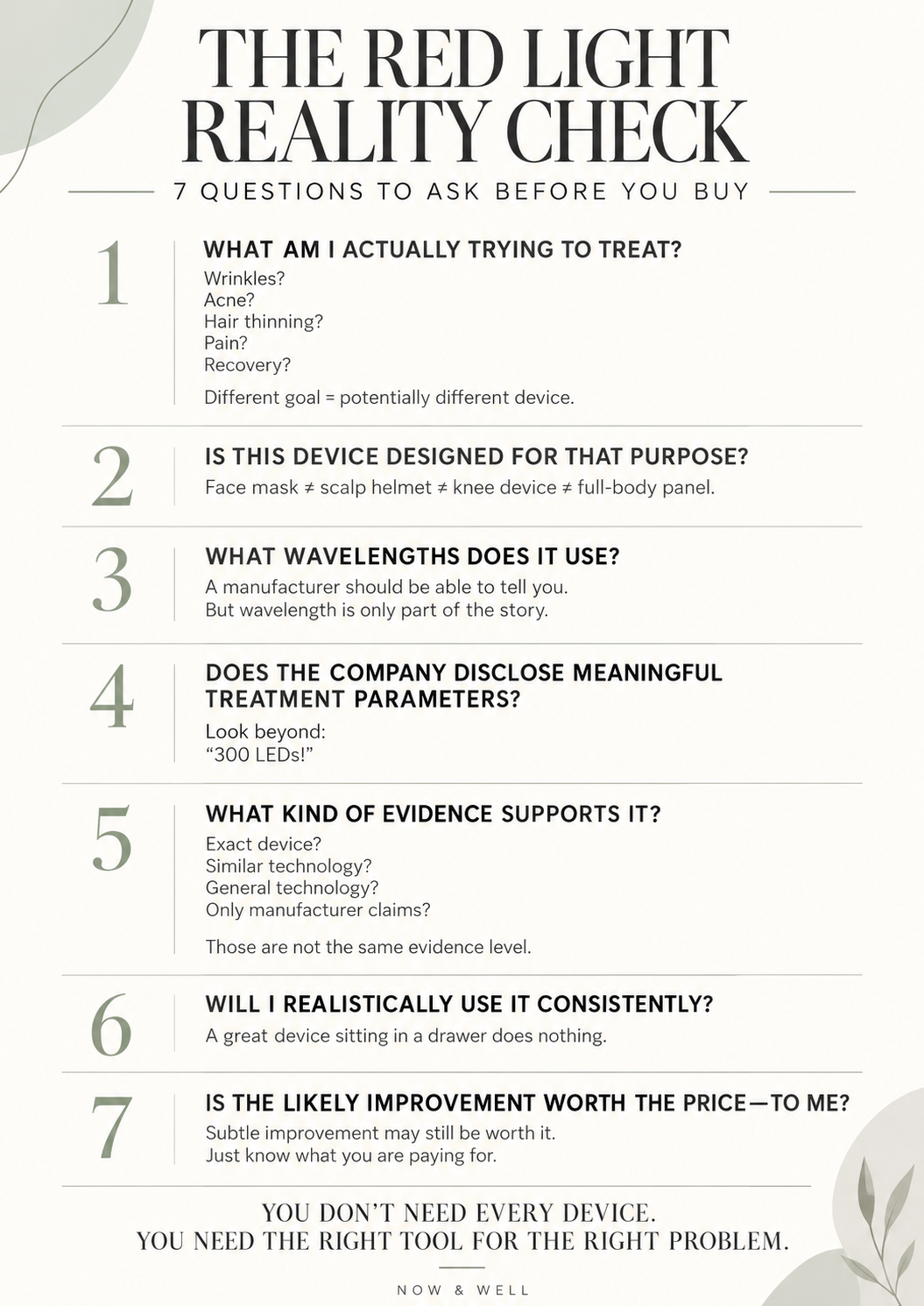
The Red Light Reality Check

Before buying any red-light device, ask these seven questions.

1. What am I actually trying to treat?

Wrinkles?

Acne?

Hair thinning?

Pain?

Recovery?

Different goal = potentially different device.

Now and Well Red Light Reality Check for evaluating LED devices

2. Is this device designed for that purpose?

Face mask ≠ scalp helmet ≠ knee device ≠ full-body panel.

Do not let the phrase “red light therapy” flatten all of these into one product category.

3. What wavelengths does it use?

A manufacturer should be able to tell you.

But remember:

wavelength is only part of the story.

4. Does the company disclose meaningful treatment parameters?

Look beyond:

“300 LEDs!”

Ideally, the manufacturer provides enough information to understand how the device is intended to be used and what dose/protocol supports its claims.

5. What kind of evidence supports it?

This is one of my favorite questions.

Is there:

  • research on the exact device?
  • research on a very similar device?
  • research on the general technology?
  • traditional or theoretical support?
  • only manufacturer testimonials?

Those are not the same evidence level.

6. Will I realistically use it consistently?

Three to five times a week can sound easy when you are excited about a new gadget.

Ask yourself again three months later.

If you hate wearing it, charging it, cleaning it or sitting still with it, the “perfect” device may not be perfect for you.

7. Is the likely improvement worth the price—to me?

This question is personal.

A subtle improvement can absolutely be worth paying for.

But you should know you are purchasing subtle improvement, not imagining a facelift in a box.

Who Should Be Careful With Red Light Therapy?

Short-term use appears generally well tolerated, but “noninvasive” does not mean “appropriate for everyone.”

The American Academy of Dermatology recommends extra caution if you:

  • have a condition that makes you sensitive to light, such as lupus
  • use medication that increases photosensitivity
  • have an existing skin condition that light could aggravate
  • have questions about whether a device is appropriate for your skin or hair concern

You should also follow the eye-protection instructions that come with the exact device.

Do not assume that because one mask is designed for use with eyes open, every red-light or near-infrared device is.

What About Darker Skin Tones and Hyperpigmentation?

This deserves more attention than it gets.

The American Academy of Dermatology notes that darker skin tones may be more sensitive to visible light and that this sensitivity can contribute to hyperpigmentation in some people.

That does not mean women with deeper skin tones should automatically avoid red-light therapy.

It means we should stop pretending that every technology behaves exactly the same way in every skin tone.

If you are prone to stubborn pigmentation or melasma, this is a reasonable reason to discuss the specific device with a dermatologist before investing—especially when the device also contains heat or multiple energy modalities.

Can I Use Red Light With Retinol or Acids?

In many skincare routines, red light and topical actives can coexist.

But there is no prize for irritating your skin.

If your skin is:

  • burning
  • peeling
  • inflamed
  • excessively dry
  • sensitized from a peel
  • recovering from an aggressive treatment

I would not pile on another modality simply because your calendar says “LED day.”

If dryness and sensitivity are part of what you are navigating, read Why Is My Skin So Dry in Menopause — Even When I Moisturize? — it walks through what menopause may change in the skin and why moisturizer sometimes is not enough.

Skin first.

Schedule second.

Also check the instructions for the exact device and the topical product you are using, especially if the medication or ingredient can increase photosensitivity.

How Often Should You Use Red Light?

There isn’t one universal schedule.

Different devices use different:

  • wavelengths
  • intensities
  • treatment durations
  • treatment distances

So I do not recommend taking the treatment schedule from one brand and applying it to another device.

The 2025 facial-rejuvenation study used 21-minute treatments two or three times per week for four weeks and found that twice-weekly treatment produced positive outcomes without evidence that three weekly sessions were substantially better for the measured endpoints.

Solawave, on the other hand, instructs users to use its wand three to five times weekly.

Follow the protocol for the actual device.

More is not automatically better.

When I Think an LED Device May Be Worth the Money

I think it becomes a reasonable purchase when:

You know what you want it to treat.

Not:

“I heard red light is good.”

But:

“I want a realistic at-home adjunct for fine lines and overall skin quality.”

That’s much better.

The device is designed for that use.

This sounds obvious until you start shopping.

There is credible evidence behind the modality.

LED for facial rejuvenation has a better evidence base than many beauty gadgets being sold online.

Your expectations are realistic.

Improvement?

Potentially.

Transformation?

That is usually where marketing outruns biology.

You can use it consistently.

Consistency is a treatment variable.

Not a personality test.

If the device is too inconvenient for your life, choose another approach.

When I Would Save My Money

I would hesitate if:

The company won’t tell you what is actually inside the device.

Lots of buzzwords.

Very few specifications.

No thank you.

The claims are enormous.

If one mask supposedly fixes:

wrinkles + acne + melasma + rosacea + sagging + hair loss + inflammation + chronic pain + sleep + hormones...

we’ve crossed from skincare technology into mythology.

You are expecting it to replace medical care.

Especially for:

  • unexplained hair loss
  • severe acne
  • persistent pain
  • suspicious skin changes
  • significant inflammatory conditions

A device can complement care.

It should not delay diagnosis.

You already know you won’t use it.

This is probably the most expensive form of optimism in the beauty industry.

What I Want You to Remember About Pain

Because we expanded this discussion beyond skincare, I want to repeat this one.

There is legitimate research into photobiomodulation for conditions involving pain and musculoskeletal function.

The knee-osteoarthritis evidence, for example, suggests potential benefit—but the certainty is still very low, and researchers do not support replacing established therapies with PBM alone.

The shoulder/neck literature is promising, but treatment protocols vary considerably.

So the correct conclusion is not:

“Red light treats arthritis.”

It is:

Photobiomodulation is being studied as a potentially useful tool for certain pain conditions, but the evidence and treatment protocols depend heavily on the condition and the device.

That may not fit nicely on the front of a red-light box.

But it is much more useful.

So...Does Red Light Therapy Work?

This is where I land.

For facial rejuvenation:

Evidence-supported enough to take seriously.

There is moderate evidence for home LED devices, including randomized research in women ages 45–60. Results are usually gradual rather than dramatic.

For acne:

It depends on the light and the type of acne.

Blue and combined blue-red devices have better home-use evidence than red light alone, and visible light is better suited to inflammatory pimples than blackheads, cysts or nodules.

For hereditary hair loss:

Promising and supported by human trials for appropriately designed devices.

But diagnose the cause of hair loss first.

For pain:

Promising in some conditions, but much more protocol-dependent and less settled than the internet sometimes suggests.

The device matters enormously.

The Bottom Line

Red light therapy lives in an uncomfortable place for consumers.

It is legitimate enough that we should not dismiss it as another silly beauty gadget.

But it is popular enough that marketers can attach almost anything to it.

The answer is not to become cynical about every device.

The answer is to become a better filter.

Ask:

What am I treating?

What technology is actually inside this product?

Was this device designed for that goal?

What does the evidence really support?

What will I realistically get for the money?

Because you do not need every mask, wand, helmet and glowing panel Instagram puts in front of you.

You need the right tool for the right problem.

And sometimes the most intelligent beauty purchase is not buying the device at all.

You don’t need everything. You need what works for you now.

— Margarita

Read Next: Is Menopause Changing Your Skin Too?

If your face has become suddenly dry, tight or uncomfortable—even though you are moisturizing—read Why Is My Skin So Dry in Menopause — Even When I Moisturize?.

It explains what menopause may change in the skin, why moisturizer sometimes is not enough, and how to troubleshoot your routine before buying another product.

Frequently Asked Questions

This article is for general educational purposes and does not provide medical diagnosis or treatment. Consult an appropriate licensed healthcare professional for medical concerns.

Still deciding whether a device belongs in your routine?

If you’d rather have someone review what you’re using, what changed, and what may actually make sense for your skin now, The Midlife Skin Reset consultation is designed for exactly that.